
There is a zone on a football pitch that has no clear owner. It sits between the central channel and the wide area — too central to be a winger’s territory, too wide to be a striker’s domain. Defenders struggle to agree on whose responsibility it is. Coaches have spent two decades trying to either flood it with clever runners or seal it off entirely. Analysts have written hundreds of thousands of words attempting to explain what it does to a defensive shape when an intelligent attacker occupies it.
That zone is the half-space. And it is, by some margin, the most contested and most consequential piece of territory in the modern game.
This publication takes its name from it. That is not an accident.
Understanding the half-space — what it is, why it matters, who has mastered it, and why it is almost impossible to defend — is understanding something fundamental about how football is actually played at the highest level. Not the football of the highlight reel or the broadcaster’s camera angle, but the chess beneath the surface. The game within the game.
The Geometry: Dividing the Pitch
To understand the half-space you first need to understand how modern coaching theory maps the width of a football pitch.
Think of the pitch divided vertically into five channels, running from goal-to-goal like stripes on a flag. The central channel runs through the spine of the pitch — the goalkeeper, the defensive line, the midfield pivot, the striker. The two outermost channels are the wide areas: the territory of the wingers, the fullbacks, the touchlines. Between the central channel and each wide channel sits a narrower zone on each side of the pitch.
Those two in-between zones are the half-spaces.
In German coaching terminology — and German football has given us much of the language we now use to analyse the game — this area is called the Halbraum. Translated literally, that is “half-room.” A space that is neither the room in the middle nor the room on the outside, but something in between. Something that belongs to no one and everyone at the same time.
Measured in approximate pitch thirds, the half-spaces on a standard pitch run from roughly fifteen to thirty metres from each touchline, stretching the full length of the field. They exist in both the defensive and attacking halves. But it is in the attacking half — specifically in and around the opposition’s penalty area and the thirty-metre zone in front of it — where their importance becomes acute.
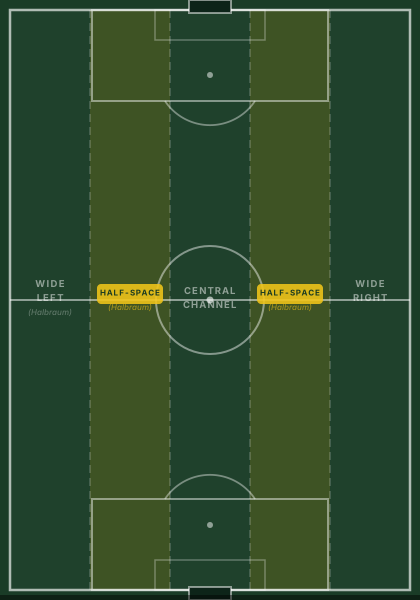 The pitch divided into five vertical channels. Channels 2 and 4 — the half-spaces — are highlighted. No single defender owns them.
The Defensive Dilemma
Why does occupying the half-space cause such problems for the team without the ball? The answer lies in how defences are organised.
A defensive block — whether a flat four, a compact four-four-two, or a deep five-four-one — is fundamentally designed to protect the central channel. Every player in every formation understands that the most dangerous area on the pitch is the channel through the middle: the lane through which a striker can receive, turn, and shoot. So the centre-backs protect the middle. The defensive midfielder drops in front of them. The shape contracts around that central zone.
Wide areas, meanwhile, are defended differently. A winger making a run down the flank is dangerous but somewhat contained: the cross must still be good, the striker must win his header, and the goalkeeper has a strong angle. The wide areas matter but they do not terrify defenders in the same visceral way as a ball played through the centre.
The half-space sits between these two defended zones. And here is the dilemma it creates: a player receiving the ball in the half-space — positioned, say, twelve yards outside the penalty area on the right side — is neither central nor wide enough to be cleanly assigned to any single defender. Is he the centre-back’s problem? The fullback’s? The holding midfielder’s?
This ambiguity is not a bug of the half-space. It is the feature.
When a team is well-organised and compact, this ambiguity is managed — defenders communicate, they squeeze the space, they prevent the ball entering that zone. But the moment a half-space runner times his movement well, receives the ball at pace, and faces goal with a full view of the penalty area, the defence is forced into one of two impossible choices: step out to press and create a gap in the defensive line, or hold shape and allow the attacker to pick his moment. Neither is comfortable. Both lead somewhere dangerous.
From the half-space, an attacker has angles that simply do not exist from the centre or the flank. He can shoot across the goalkeeper into the far corner. He can play a cut-back to a late runner arriving at the near post. He can drive into the penalty area along a diagonal that no defender can track without switching their body orientation. He can switch the play in a single pass to an unmarked fullback arriving in the opposite half-space.
The half-space does not just create one threat. It creates a branching tree of threats — each of which the defence must simultaneously account for.
The half-space sits between two defended zones. A player receiving there is neither the centre-back’s problem, nor the fullback’s, nor the holding midfielder’s. This ambiguity is not a bug. It is the feature.
The Raumdeuter: When Football Got Its Language
The concept of exploiting these in-between zones is not new. Coaches and players have intuitively understood this territory for decades. But the moment the half-space entered the broader football conversation — when it went from coaching jargon to a widely used analytical term — can be traced, at least in popular understanding, to a single interview in 2011.
Thomas Müller was twenty-two years old. He had just won the World Cup Golden Boot with Germany, having scored five goals at South Africa 2010. He was already one of the most discussed attacking players in European football. And when a German journalist asked him to explain his role in Jupp Heynckes’ Bayern Munich side — he was neither a striker, nor a winger, nor a number ten — Müller paused and then answered: “Ich bin ein Raumdeuter.”
A space interpreter.
The word came from Müller himself. Raum is the German for space or room. Deuten means to interpret or to read. A Raumdeuter, then, is a player whose primary gift is not physical pace or technical brilliance but something rarer and harder to coach: the ability to read and arrive in spaces before they close.
Müller’s genius, and the reason his career produced a remarkable output of goals and assists despite him never being a conventional forward, was that he understood where spaces would appear — in the half-space, at the back post, in the gap between a retreating centre-back and a stationary defensive midfielder — and he arrived there as the ball arrived there. Not a second before, which would alert the defence. Not a second after, which would mean the moment had gone. Precisely when the space existed.
His movement in the half-space was not spectacular. There were no step-overs, no shoulder drops, no audacious long-range strikes. He would drift from a central starting position, make an angled run across the face of the defence, and arrive unmarked in an area that looked, on paper, like it should have been covered. The goal was often simple — a composed finish, a side-foot, a tap-in. The work that created it was anything but.
“Ich bin ein Raumdeuter.” A space interpreter. Not a striker, not a winger, not a ten — a reader of rooms that others haven’t noticed yet.
Müller spent twenty-five extraordinary years at Bayern Munich, winning twelve Bundesliga titles and two Champions League crowns before leaving the club in the summer of 2025. The term he gave to his role — Raumdeuter — gave football an idea it was already thinking, and a word to think it with.
Before the Language Existed: Historical Half-Space Operators
The Raumdeuter label arrived in 2011. The concept it described had been visible, nameless and unchartable but unmistakably real, for decades before that. The half-space was not invented by analysts. It was discovered — repeatedly, and independently — by a series of elite players who operated within it not because a coach had identified it as a structural priority, but because their instincts told them that the in-between territory was where the game was actually won.
Three players in particular demand examination here, because each of them, in a different era and a different context, did something that the language of the time could not quite explain.
Zinedine Zidane at Real Madrid between 2000 and 2006 provides perhaps the most architecturally significant case. Zidane was nominally a number ten — a classic attacking midfielder — but within the Galácticos structure, which deployed Ronaldo Nazário as the central striker and Raúl inside on the left, Zidane operated with a positional freedom that invariably carried him into the right half-space. The arrival of David Beckham in 2003 accelerated this dynamic: Beckham’s natural position on the right meant the ball consistently arrived in that channel, and Zidane would position himself to receive not as a wide midfielder but as someone occupying the gap between Beckham’s area and the penalty arc.
What Zidane did from that zone was the prototype of what Iniesta would later do, in more structured fashion, at Barcelona. He received facing towards goal — his body shape open, his first touch killing the ball instantly — and used the space to make decisions. Runners behind the defensive line. Cut-backs to the arriving Ronaldo. Direct shots at goal. The roulette — his signature turn — was most dangerous not when executed in the centre of midfield but when he performed it in the half-space, because in that zone the space behind him was unoccupied and the defenders marking him were unsure whether to step or hold. The turn exploited precisely the ambiguity of ownership that defines the half-space. He simply had not been given the vocabulary to articulate it.
Gianfranco Zola at Chelsea from 1996 to 2003 represents a different kind of historical half-space operator — one whose influence on English football was diffused rather than concentrated, because the English game at the time had no structural framework into which to absorb what he was doing.
Zola was a trequartista in the Italian tradition: a free attacking midfielder who operated in the ten channel but drifted wide to receive and then moved centrally to finish or create. The trequartista role, developed in Italian football through the 1980s, was in effect an institutionalised form of half-space occupation — a position explicitly designed to live between the lines and between the wide and central channels. When Zola arrived at Chelsea under Ruud Gullit, English managers and journalists struggled to define his role with the language available. He was not a winger. He was not a striker. He was not a central midfielder. He occupied a gap that did not have a name in the English football lexicon.
What he produced from that unnamed zone was extraordinary. His runs into the right half-space — cutting in from a semi-wide position to shoot across the goalkeeper at the near post — were almost impossibly difficult to track because they began in a position that looked innocuous. His time at Chelsea coincided with some of the first serious structural discussions in the English game about how Italian and Spanish football managed space differently, but the conclusions were impressionistic rather than systematic. The half-space was producing goals. Nobody had a clean theory for why.
Pavel Nedvěd at Juventus — particularly across his Ballon d’Or season of 2002-03 — showed the half-space working from the opposite side, and with a different physical profile. Nedvěd was powerful, direct, and capable of sustained high-intensity running across ninety minutes in a way that Zola was not. But his positional intelligence in the left half-space was as precise as any of his contemporaries. From that zone, cutting inward from a nominally left-midfield starting position, he generated goals and chances that did not look possible from the angles involved.
His signature was the inward run followed by a strike from the edge of the penalty area across the goalkeeper. The angle was wrong for a right-footed shot. That, precisely, was the point: the shot generated by entering the left half-space and curling the ball across to the far post wrong-footed the goalkeeper and exploited the visual geometry that the half-space creates. Defenders tracking him expected him to cross or lay off; Nedvěd’s habit of shooting at moments when a cross seemed the obvious option was a direct product of occupying a zone where the shooter’s options remain genuinely multiple until the last instant.
The common thread connecting Zidane, Zola, and Nedvěd is not tactical sophistication in any coached sense. None of them were operating within a system that explicitly identified half-space occupation as a structural goal. All three were doing it because their football intelligence had led them, through repetition and instinct, to the same conclusion: that the in-between zone was where defenders were most confused, and therefore where the most dangerous things could happen. They had found the half-space before anyone had given it a name.
Iniesta in the Half-Space: The Greatest of Them All
If Müller gave the half-space its language, Andrés Iniesta gave it its most devastating expression.
The Barcelona side of 2009 to 2012 — the Guardiola team that won back-to-back Champions Leagues and produced perhaps the most complete expression of positional football ever assembled — is most often described through its central triangle: Xavi’s radar-precise distribution, Busquets’ invisible defensive excellence, and Messi’s otherworldly unpredictability. But the player who made that machine truly unstoppable, the player who defenders most feared having to mark in tight spaces, was the compact and deceptively quiet figure who drifted through the left half-space like water finding gaps in rock.
Iniesta was not fast. He was not physically imposing. He did not shoot often or from distance. What he did — what made him, in the opinion of many serious tactical analysts, the hardest player in the history of the game to stop in a small space — was manipulate his body so completely, with touches so disguised and changes of direction so abrupt, that defenders lost him in the area they had no clear ownership of.
He would start centrally, draw the defensive midfielder toward him, then drift into the left half-space as the ball moved. By the time a defender had identified the threat and moved to close, Iniesta had already received, already shifted his weight, already made the decision. The ball was gone before the tackle arrived. A pass into the penalty area, a switch to Dani Alves, a lay-off to a runner — the choice was made in fractions of a second, in a zone where the defence had momentarily lost its organisational clarity.
The 2009 Champions League semi-final goal against Chelsea — struck after receiving in the half-space, the ball seemingly going out of play before Iniesta’s volley sent Barcelona to Rome — is the most famous example. But it was not representative of his half-space work. Most of it was quieter, more structural, less dramatic. It was the ten passes before the goal. The five times he received in that zone and recycled efficiently. The way Barcelona’s system, under Guardiola, was specifically designed to funnel the ball through those channels because they had identified the Raumdeuter in their midfield and built their attack around him.
The Modern Masters
The half-space has never lacked for outstanding interpreters, but the current generation has produced several players who represent its most varied and complete expressions.
Jude Bellingham at Real Madrid uses the half-space differently from Müller or Iniesta — not as a ball-receiver in tight spaces, but as a late runner arriving at the moment the half-space opens between the opposition’s defensive line and their recovery shape. His movement from deep is the key: he begins a run from midfield as the ball travels wide, and by the time a cross or lay-off is played, he is arriving into the right half-space — or cutting across the penalty area from the left — at a moment when no defender has clearly picked him up. His goals for Real Madrid have frequently come from exactly this pattern: the diagonal run, the low cross or pull-back, the confident finish from twelve yards having ghosted into a zone no one quite owned.
Florian Wirtz, who joined Liverpool from Bayer Leverkusen for £116 million in the summer of 2025, represents a different archetype again. His half-space play is more like Iniesta’s than Bellingham’s: he receives between the lines, manipulates in tight spaces with remarkable composure, and makes quick decisions that open defences at angles they cannot recover from. Under Xabi Alonso at Leverkusen, he was the central mechanism of a system that deliberately overloaded both half-spaces simultaneously — the shape designed to force defenders into impossible choices between marking the man in the half-space and holding the defensive line.
Jamal Musiala at Bayern Munich has emerged as one of the game’s most instinctive half-space readers — a player who operates somewhere between Müller’s movement and Wirtz’s technical execution, drifting through channels with the ease of someone for whom spatial awareness appears to be a native language rather than a learned skill.
What each of these players shares — despite the differences in their roles, their physical profiles, and their teams’ tactical systems — is the understanding that the most valuable piece of a football pitch is not in the middle, and not on the wing. It is in between.
How Teams Structure to Exploit the Half-Space
The individual brilliance of a half-space player is multiplied when the team structure is specifically designed to create access to those zones. Modern tactical evolution has produced several recurring mechanisms for doing this.
The inverted winger is the most widely understood. A naturally left-footed player deployed on the right wing — or right-footed player on the left — instinctively cuts inside when he receives, which means he is moving into the half-space every time he takes the ball. This became so common across the 2010s that it reshaped how fullbacks were deployed: the overlap from the fullback pulls the opposition winger back, opening a lane for the inverted winger to drift centrally into the half-space. The relationship between an inverted winger and an overlapping fullback is essentially a two-player machine for generating half-space access.
The false nine creates half-space access for midfield runners. When the nominal striker drops deep to receive and play, both centre-backs face a choice: follow him and leave space in behind, or hold and let him turn. This moment of defensive hesitation creates a window in which runners from midfield — specifically runners arriving through the half-space — can exploit the gap that forms behind the defensive line as it is pulled out of shape.
High fullback positioning is the third mechanism. Pep Guardiola’s tactical evolution at Manchester City took this concept and compressed it further: by pushing his fullbacks high and inverted into central-midfield positions, he freed his wingers to stay wide while his midfield overloaded the half-spaces with numerical superiority. The 4-3-3 that becomes a 3-2-5 in possession is, at its core, a mechanism for concentrating intelligent runners in and around the half-spaces on both sides simultaneously.
Overloads in the Half-Space: The Three-vs-Two Problem
The structural mechanisms for accessing the half-space — the inverted winger, the false nine, the high fullback — are most effective when they are not used in isolation but layered together to create numerical overloads. The most consequential innovation in positional play over the last decade is not the identification of the half-space as a dangerous zone. That recognition is now universal. The innovation is the systematic construction of three-versus-two situations within it, so that whichever defender steps to engage the ball-carrier, a free man exists elsewhere in the same zone.
The logic runs as follows. A defending team that is well-organised will assign responsibility for the half-space to three players: the wide centre-back, the fullback tucked in, and the near-side central midfielder. Two of these three will be involved in tracking the primary half-space attacker and the first supporting runner. The third — almost always the central midfielder, drawn slightly toward the ball — is the one who loses the late-arriving third man. Modern positional play structures its half-space approach around exploiting this specific gap in defensive coverage.
The triangle that Guardiola’s teams construct in the half-space has become the most replicated attacking mechanism in elite club football. Its components are the winger positioned deep to draw the opposing fullback out of line; the attacking fullback pushing high to occupy the space vacated; and the inverted midfielder — the player in the mould of Kevin De Bruyne or Ilkay Gündogan — arriving into the half-space itself as the primary receiver and decision-maker. What this creates is a triangle of three attacking players in a zone that the defence has organised two players to cover. The arithmetic favours the attackers before any individual quality is factored in.
The delivery mechanism that makes this triangle genuinely dangerous is what coaches now call the third-man run. The ball travels from the deep winger to the half-space midfielder. In the moment between the pass being played and the midfielder receiving it, a third attacker — typically a central midfielder who has stayed slightly deeper before making a late run — begins a diagonal movement toward the penalty area from outside the triangle. The defence, focused on the ball-carrier in the half-space and the nearest supporting runner, does not see this third movement until it is too late to track. The half-space receiver lays the ball off at the precise moment this third runner arrives at pace, and the resulting attempt on goal comes from someone who has entered the shooting zone without ever being marked.
The pattern is not hypothetical. It is the mechanism behind a significant proportion of the most dangerous goal-scoring opportunities created by Barcelona, Manchester City, and Bayer Leverkusen over the last five seasons. The half-space is the hub through which the movement is routed because it is the zone where the defence’s collective communication is most strained.
Barcelona’s current edition has produced the most compelling version of this triangle in European football. The combination of Lamine Yamal and Pedri in and around the half-space has, across the 2024-25 and 2025-26 seasons, begun to recapture something of the spatial intelligence that defined the Iniesta and Messi partnership at its peak. The mechanism is distinct — Pedri operates more explicitly as the half-space receiver, Yamal’s role carries more of the wide-to-central movement — but the effect is similar. Pedri collects in the right half-space between the opposition’s defensive line and their midfield block. His composure on the ball forces the nearest defenders to commit. And into the gap that commitment creates, Yamal arrives — not from wide, but from a diagonal run beginning outside the penalty area — to receive the lay-off and finish from close range at the back post.
The visual signature of this combination is striking precisely because it looks simple. One pass, one run, one finish. The complexity is invisible unless you track the defensive shape in the seconds before the pass was played and understand how the triangle built around Pedri’s half-space occupation drew the coverage that left Yamal’s run untracked.
The Defensive Half-Space: How the Best Teams Use It in Their Own Half
The half-space is most immediately associated with attacking football — with the late runners, the tight-space technicians, the branching tree of threats that opens when a clever midfielder receives between the lines. But the zone’s tactical significance does not begin when the ball crosses the halfway line. The half-space is equally consequential in build-up play and in the management of defensive transitions, and the teams that understand this dual function gain a structural advantage that goes beyond what any single attacker can provide.
The key insight is that the half-space in a team’s own defensive or midfield third provides the ideal receiving position for players looking to progress the ball under pressure. A centre-back standing in the central channel can be pressed from directly in front; the pressing player needs only to run straight to close him down. A centre-back who drifts into the half-space to receive creates a different geometry for the press. The pressing player must travel further, on a diagonal, and the defensive player receiving the ball has both a wider range of forward passing options and a clearer angle to play through or around the approaching pressure.
This is the principle that underlay Sergio Busquets’ positioning during Barcelona’s dominant years under Guardiola, and it is a principle that has subsequently been absorbed into the build-up architecture of virtually every team that plays out from the back at the highest level. Busquets was not positioning himself in the left half-space to receive attacking passes. He was positioning himself there in transition moments — specifically in the seconds after Barcelona lost the ball — to occupy the space from which he could either intercept the opposition’s first pass or, if his team regained possession immediately, begin the next attacking sequence from a position that was already facing forward and already outside the central press.
The defensive-half-space function of Busquets was essentially this: he cut off the most dangerous distribution angle available to the team that had just won the ball. A team winning possession in their own midfield wants to play quickly forward before the opposition’s press reorganises. Busquets, by occupying the left half-space immediately on transition, denied them that option without having to make a press himself. His positioning was a passive defensive act executed from an attacking-oriented zone.
The explicit structural evolution of this principle arrived at Manchester City in the form of John Stones in the role that Guardiola developed for him from the 2021-22 season onward. Stones, a centre-back by position, was asked to move into the left half-space during City’s build-up phase, effectively functioning as an additional midfielder without the ball being played through a traditional midfield line. The tactical logic was precise: Stones’ movement into the half-space created a third option for City’s ball-progression beyond the two obvious routes of the central spine or the wide fullback. The opposition’s press could track two players cleanly; the third, arriving in the half-space from a position the press had not accounted for, was routinely available to receive and play forward into the attacking structure.
The innovation was not the movement itself — midfield-dropping centre-backs are not new — but the half-space specificity of it. Stones did not drop into the central channel, which is the intuitive position for a recovering defender. He dropped into a channel where the press could not easily follow him because following would create a gap elsewhere. The half-space, even in a team’s own half, functions as a press-resistant zone.
Trent Alexander-Arnold’s career at Liverpool, and subsequently at Real Madrid, has provided the most widely discussed illustration of what a player liberated from wide-channel positioning can do when the half-space becomes their primary operating zone. Alexander-Arnold began his Liverpool career as a conventional right back — exceptional technically for the position, but still fundamentally positioned in the wide channel. The evolution of his role under Jürgen Klopp, and then under Arne Slot, moved him progressively into the right half-space both during build-up and in attacking phases.
The results are measurable and stark. A traditional right back positioned in the wide channel can cross and deliver set pieces. An intelligent player positioned in the right half-space can receive between the opposition’s lines, face goal, and play diagonal passes that reach the opposite half-space or the striker in behind — passes that a player standing ten metres wider simply cannot execute at the angle and speed required. Alexander-Arnold’s assist numbers have consistently tracked those of elite central midfielders rather than elite fullbacks because the half-space gives him a central midfielder’s range of passing options. The position creates the output. The player executes it.
What these examples share is the understanding that the half-space is not simply an attacking destination. It is a spatial resource that intelligent teams use throughout the pitch to manage pressure, to progress the ball, and to make their build-up structure genuinely difficult to press coherently. The team that controls both half-spaces in their own half is, at the moment of transition, already halfway toward constructing their next attack.
Set Pieces and the Half-Space: Where Corners Are Really Aimed
The conversation about the half-space tends to focus on open play. The positional rotations, the three-versus-two triangles, the late runners arriving from midfield — these are the mechanisms that analysts spend most of their time mapping. But some of the clearest statistical evidence for the half-space as the decisive zone in modern football comes not from open play at all, but from set pieces. Specifically, from the research that has accumulated over the last decade into where corners and dead-ball situations are most effectively delivered.
The popular assumption about corner delivery — an assumption reinforced by years of broadcasting commentary and coaching orthodoxy at lower levels — is that the most dangerous delivery targets the six-yard box or the penalty spot. These are the zones a traditional corner-kick analysis would identify as the high-probability areas: near the goal, in the crowded space where aerial duels are won and tap-ins are scored. The analytical reality is different, and the difference is significant.
The delivery zone with the highest conversion rate in elite football is not the six-yard box. It is the near-post half-space — roughly six to ten metres from goal, in the channel between the near post and the edge of the six-yard box on either side. The ball delivered to this zone, at the pace and trajectory that a near-post runner can attack rather than defend, generates the most dangerous combination in dead-ball football: the flick-on to the far-post runner. A player attacking the near-post half-space can change the ball’s direction with minimal contact, sending it across the face of goal to a second runner arriving at the back post who has deliberately avoided the congested area in front of the goalkeeper. The goalkeeper cannot hold their starting position for a ball aimed at the near post and simultaneously cover the far-post delivery that follows.
The practical consequence of this analysis is visible in how the most sophisticated set-piece coaches in the game now design corner routines. Mikel Arteta’s Arsenal have been consistently among the most creative and productive set-piece teams in the Premier League across recent seasons, and their corner design reflects a precise understanding of the near-post half-space geometry. Their routines typically involve a deliberate near-post runner whose function is not to score from the delivery — his arrival draws defenders forward and compresses the near-post channel — but to create the second-phase opportunity at the back post for an arriving midfielder, who is explicitly targeting the space that the goalkeeper has vacated in order to threaten the near-post movement.
Guardiola’s City have been even more systematic in using the half-space for set-piece delivery. Their free-kick routines from wide positions on the right — positions that fall naturally into the right half-space — have included multiple variations on the principle that the near-post flick-on to the back post is more valuable than any direct delivery into the crowded centre. The aim is not the crowd. The aim is the space behind the crowd, in the half-space at the back post, that the defending team has failed to occupy because they are concentrated in the central channel.
Free kicks struck from the half-space itself represent a separate category of dead-ball danger that deserves examination independently. A free kick from the central channel gives the goalkeeper a symmetrical problem: equal threat on both sides, requiring a central starting position and the ability to travel either way. A free kick from the half-space presents an asymmetric problem. From roughly twenty-five to thirty metres out in the right half-space, a right-footed striker can aim for the far top corner with a naturally curling ball that travels across the goalkeeper’s body on a trajectory the goalkeeper has limited time to track, or can drive the ball under the wall and through the near post — a delivery that was almost impossible to execute from a central position. The defender organising the wall cannot set it both to protect the near post and to force the kick toward the goalkeeper; from the half-space, the geometry of the free kick always favours the taker.
This is, of course, why Zidane’s free kicks were most dangerous not when struck from directly in front of goal but from the right half-space. And why the free-kick specialists who have generated the most consistent output at the highest level — David Beckham, Juninho Pernambucano, Messi at his peak — have typically been most effective from positions that fall within these channels rather than directly central ones.
Why Defending the Half-Space Is So Difficult
The half-space’s power as an attacking zone is directly related to how structurally difficult it is to defend well. A flat back four, compact in a mid-block, can cover the central channel and the wide channels reasonably well. It struggles with the half-space for a specific reason: the zones overlap with each other’s responsibilities.
When a ball arrives in the half-space on the right, the right centre-back must decide whether to step and engage. If he does, he creates a gap in the central channel. The defensive midfielder must track back into that gap, which removes him from his primary position and reduces the team’s ability to press higher up the pitch. The right fullback, meanwhile, cannot simply tuck in because the wide area must remain covered in case the ball is switched. And the left centre-back cannot drift across, because that leaves the far side exposed.
The entire defensive shape is being stretched across multiple zones simultaneously — and that is before the attacking team uses a third runner arriving from midfield to create a third threat the defence has not accounted for.
The only reliable answer is to compress the space before the ball enters it — to be so compact, so well-organised, and so proactive in press triggers that the half-space never becomes a zone where an attacker can receive with time to think. This is what elite defensive teams do: they starve the half-space of the time and space the attacker needs to be dangerous. But it requires extraordinary collective discipline, sharp pressing triggers, and the willingness to surrender territory elsewhere in order to do it.
The moment that collective organisation breaks — with fatigue, with a single pressed defender making a wrong decision, with a clever piece of movement that disorganises the shape — the half-space becomes open. And open half-spaces, in modern football, are where games are decided.
The Zone That Owns the Game
Football is always looking for the decisive advantage. The edge that turns a fifty-fifty match into a controlled performance. For much of football history, that edge was pace down the flanks, strength through the centre, or the inspired individual who could create something from nothing. And those things still matter.
But the game’s tactical evolution — through positional play, through pressing theory, through the growing sophistication of how coaches map the pitch and design structures — has converged on the half-space as the primary contested zone at the highest level. Not because every other zone is irrelevant, but because the half-space is where the deficiencies of every defensive system are most exposed.
From the half-space, you can reach everywhere. You can shoot, you can serve the striker, you can play in the fullback, you can switch the play. From wide, your options are narrower. From the centre, the defensive press is at its tightest. But from the in-between zone — the Halbraum, the half-room — the entire pitch opens up like a door someone forgot to lock.
Thomas Müller named it. Andrés Iniesta defined it. An entire generation of players, coaches, and analysts have spent the last fifteen years trying to own it.
This publication is named after it for a reason. Every match, at every level, is being contested in those two narrow corridors on either side of the central spine. The team that wins them — through movement, through structure, through intelligent runners arriving at the right moment in the right zone — wins significantly more than their share of games.
Once you see the half-space, you cannot unsee it. Every tactical decision, every piece of movement, every defensive shape you watch will be filtered through it. That is, in the end, what the best football analysis does: it changes the lens through which you see the game.
Welcome to The Half Spaces.