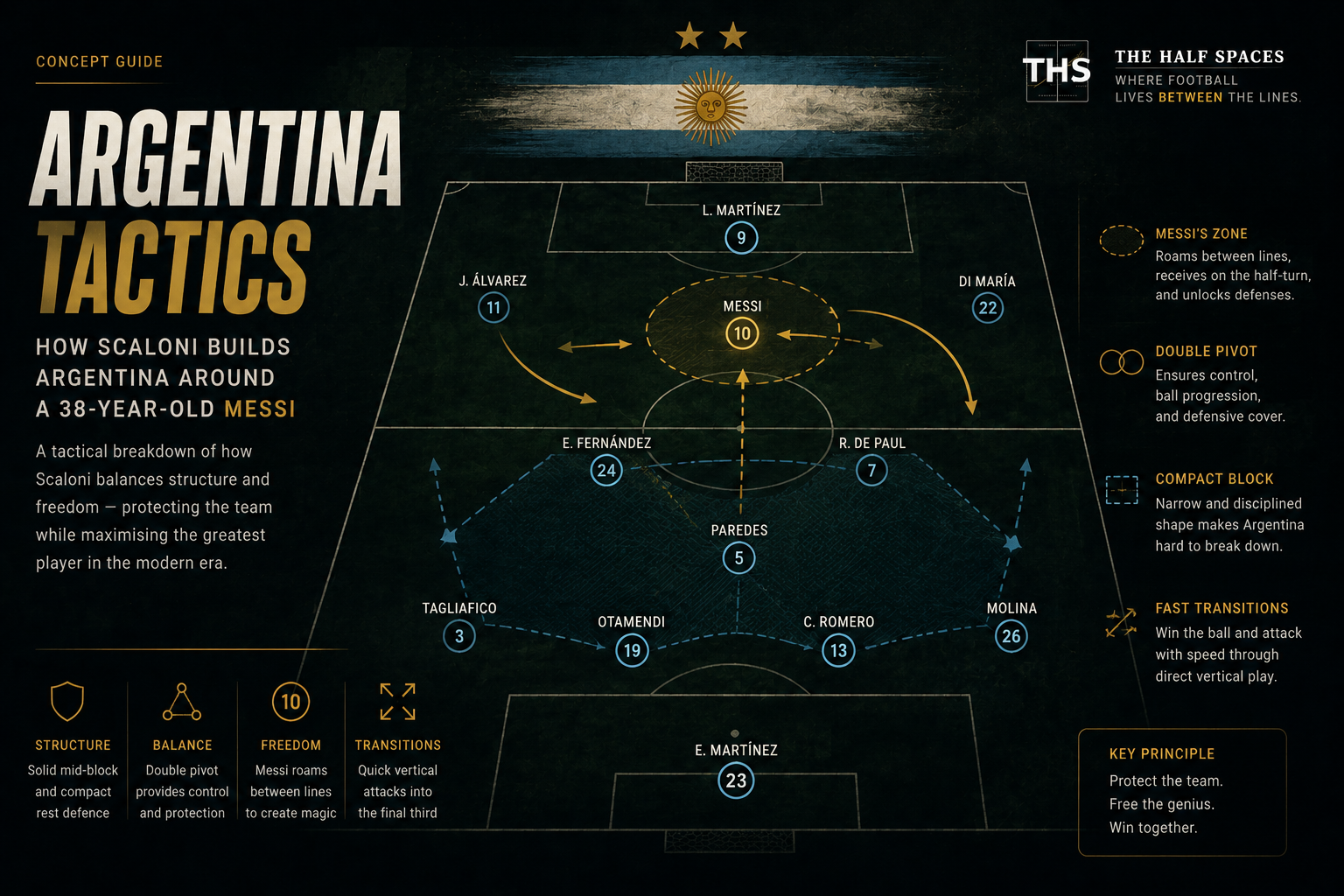
There is a version of this story where the tactical question at the heart of Argentina’s World Cup campaign is whether they can repeat 2022. That version is too simple. The more precise question — the one that determines whether they win in Canada, Mexico and the United States as they won in Qatar — is whether Lionel Scaloni has built a system sophisticated enough to generate World Cup-level performance from a thirty-eight-year-old Lionel Messi who has spent the past two seasons playing in a league that does not prepare anyone for what knockout football at a major tournament demands.
The answer is that Scaloni has, in fact, done exactly this. Argentina’s tactical structure for 2026 represents the most carefully calibrated system built around a single player’s physical limitations in the history of the tournament. It is not a concession to those limitations. It is an engineering solution. Messi’s conserved energy is the weapon. The system is designed to put him in the right place at the right moment, with the right players having done the running that he no longer can, so that his two or three decisive contributions per match land with the force of a man who has spent ninety minutes waiting for exactly this.
What Scaloni Learned from 2022
The 2022 World Cup final against France was the greatest advertisement ever made for the argument that tactical intelligence matters more than the sum of individual parts. France had Mbappé, who scored a hat-trick. Argentina had a system. The system won.
What Scaloni understood during the run to Lusail — and what he refined in the Copa América victories of 2021 and 2024 — is that Messi is most dangerous not as a forward pressing from the front, not as a wide player tracking back, but as a right-of-centre free agent who receives the ball in zones where he can assess in two touches and execute with the third. Every element of Argentina’s tactical structure has been developed to maximise the frequency and quality of those moments.
In 2022, Messi operated nominally from the right but spent most of his time centrally and at a level somewhere between the opposition’s lines, receiving in areas where defensive organisation has not yet fully resolved. He was thirty-five then. He still tracked, still pressed, still covered distances that felt surprising for a player of his type. He averaged eleven kilometres per match across the tournament. That is not a number Scaloni expects to see in 2026.
The adjustment is not philosophical. It is physiological. A thirty-eight-year-old who has been playing forty-five-minute stints in MLS does not press like a player embedded in the intensity of the English Premier League or La Liga. Scaloni has not tried to make Messi press. He has eliminated the need for it. What he has done instead is redistribute the defensive and pressing workload across the two players who have the physical profile to carry it, and positioned Messi where his specific, unreplicable contribution to the attacking phase costs him the least in terms of energy.
The Mac Allister-De Paul Axis: The Engine Room
The structural foundation of Argentina’s system in 2026 is the midfield pairing of Alexis Mac Allister and Rodrigo De Paul. These are the two legs on which everything else stands. Without them functioning at maximum capacity, the system collapses — because without them pressing, carrying and screening in the first and second phases, Messi would need to contribute to phases of play that demand far more physical output than Scaloni intends for him.
Mac Allister arrived at Liverpool as a technically accomplished midfielder who could keep possession and pick passes in tight spaces. What Arne Slot’s system at Anfield has developed him into is something considerably more specific and considerably more valuable to Argentina: a press coordinator. In Liverpool’s structure, Mac Allister is one of the players responsible for triggering and sustaining the press — for reading when to step, when to hold, and how to cut off the pass that would allow the opponent to play through the press into a dangerous area. That reading, applied at Argentina’s level in a high-pressure tournament, is what gives Scaloni’s press structure its coherence.
De Paul brings a different quality. His contribution to this system is one of the most underappreciated aspects of Argentina’s tactical identity: the ability to carry the ball forward at pace from deep positions, absorbing pressure, and then to find Messi in the half-space with a pass that bypasses an entire line of defensive organisation. De Paul’s carrying is not spectacular in the way that Messi’s dribbling or Garnacho’s direct running are spectacular. It is functional at the highest level, which is a more valuable quality. When Argentina transition from their defensive phase into their attacking phase, De Paul is typically the player who bridges the two moments, carrying the ball twenty or twenty-five metres before releasing it. That carrying reduces the number of passes required to build, which reduces the risk of turnover, which keeps Messi in positions of influence rather than positions of defensive recovery.
The two of them together — Mac Allister pressing and organising, De Paul carrying and enabling — create the conditions for a system that appears to generate Messi’s moments almost spontaneously, when in fact those moments are the product of a precise division of labour across eight outfield players designed to present him with the ball in the right place at the right time.
Where Messi Lives in This System
The question of where Messi operates in the attacking phase is more specific than the 4-2-3-1 or 4-3-3 formation labels suggest. Scaloni’s shape is best understood not as a fixed formation but as a set of positional relationships that adjust depending on where Messi is comfortable in any given phase of play.
The nominal structure is a 4-2-3-1 with Messi in the right-of-centre position behind Lautaro Martínez as the striker. In practice, Messi moves as he needs to — drifting left, dropping deeper, arriving late. The system accommodates his movement rather than constraining it. The two midfielders behind him hold their positions more rigidly than usual precisely because Messi’s position is fluid; someone in the structure has to provide the fixed reference point, and in Argentina’s case those players are Mac Allister and De Paul.
The key zone — the area Scaloni has spent three years training Argentina to deliver the ball into — is the right half-space between approximately thirty and forty metres from the opponent’s goal. It is not the wide right channel, where a conventional right midfielder would operate and where tracking back would be required. It is not the central area, where Messi would face compressed defensive organisation and limited space to operate. It is the half-space: the strip of territory between the right channel and the centre where defensive lines tend to have a seam, where Messi can receive facing forward, and where his options — cut inside, play through, switch the angle — are maximised.
The animation above shows the mechanism in detail. When Argentina build through Mac Allister or De Paul, Messi positions himself in that right half-space, typically between the opposition’s defensive and midfield units. The moment the ball arrives at his feet, two things happen simultaneously: Lautaro Martínez makes his run off the last defender, and one of the midfielders — often Enzo Fernández when he starts alongside Mac Allister — arrives as the second-phase option. Messi’s choice in that moment — the pass that splits the defence, the drive into space, the lay-off for the late runner — is where Argentina’s attacking play originates. Everything before it has been designed to make that moment occur as frequently and in as favourable circumstances as possible.
Lautaro Martínez: The Finishing Mechanism
There is a tactical logic to the pairing of Messi and Lautaro Martínez that has become clearer since the 2024 Copa América final, when Lautaro scored both goals in the victory over Colombia. In a system where Messi operates behind the striker as the primary creative influence, the striker needs to be a player who can finish without much preparation — who can convert the half-chance created by a first-time Messi pass into a goal with minimal additional build-up. Lautaro is precisely that player.
His movement between centre-backs — the diagonal run that takes him from the far post position to the near post to exploit the moment the defender loses sight of him — is the most reliable finishing mechanism in Argentina’s attacking phase. The combination works because Messi’s deliveries are timed to arrive just as Lautaro is making that movement. A pass that looks simple in the moment contains an enormous amount of preparatory information: Messi has seen the run beginning, has read the defender’s weight, has decided that this particular ball to this particular zone at this particular pace will arrive at the same moment as Lautaro’s arrival. This is not technical proficiency in the conventional sense. It is spatial intelligence of an order that no other player in world football reliably demonstrates.
Lautaro’s hold-up play, significantly improved since the 2022 tournament, also gives Argentina an alternative option in phases where the ball cannot reach Messi quickly enough. When Argentina need to relieve pressure and establish themselves in the attacking half without the clarity to build through midfield, Lautaro can receive long balls, hold, and give the midfielders time to advance into supporting positions. This is not glamorous, but it is essential — because a system that depends entirely on the short build-up through Mac Allister and De Paul into Messi’s half-space position becomes predictable if it has no variation.
Garnacho and the Problem He Creates
Alejandro Garnacho’s inclusion in the squad is a decision about the specific type of problem Argentina need to create for opposition defences. His function in the attacking phase is not the same as Messi’s — it is not even complementary in a neat way. It is additive. Garnacho creates a different problem on the left side that opposition defensive structures cannot resolve in the same way they might resolve Messi’s influence on the right.
Messi’s impact comes from technical superiority — from the fact that receiving the ball in the right area with Messi guarantees that something defensively complex will happen. Garnacho’s impact comes from physical directness — from his ability to take defenders on in 1v1 situations and beat them with pace and technique before they have organised a second line of defence. These are not the same threat. Against a defensive shape designed to compress the centre and funnel Argentina’s attacking play into wide areas where crosses can be contested, Messi’s half-space operations become harder. Against a shape designed to sit deep and prevent Garnacho’s direct running, Messi’s influence grows because central space opens.
This creates a genuine selection dilemma for Scaloni that also functions as a tactical advantage in tournament football: he has two configurations that demand entirely different defensive responses, which means opponents preparing for a knockout match against Argentina must decide which problem they are more afraid of. The answer — compress and stop Garnacho — typically creates exactly the space Messi exploits.
When Julián Álvarez operates on the left instead of Garnacho, the profile of the problem changes again. Álvarez is a central forward more than a wide player; his instinct is to drift towards the ball rather than to stay wide and create space with his width. In the 2022 World Cup, Álvarez’s influence on the left came from the diagonal runs he made into the box from a wide starting position, arriving as the third forward in attacking sequences that Messi initiated. In 2026, that same movement is available, but with Garnacho’s direct running creating a cleaner 1v1 option, Scaloni’s preferred combination for wide open games may be Garnacho left, Álvarez in reserve as the first change — a striker substitution that gives Argentina a different dimension when the game requires more direct running off the shoulder.
Emiliano Martínez and the Knockout Weapon
Emiliano Martínez’s value to Argentina is not evenly distributed across ninety minutes of football. Over the course of a match, he is a very good goalkeeper — reliable under pressure, commanding in the air, technically sound in his distribution from goal kicks, which Scaloni has refined into an extension of Argentina’s build-up phase rather than an opportunity to clear the ball forward. Over the course of a penalty shootout, he is the most dangerous goalkeeper in the world.
This is not merely a function of his ability to save penalties, though that ability is documented and significant. It is a function of his psychological approach to penalty situations, which has been studied by opponents and nevertheless continues to be effective. The specifics of his technique in a shootout — the delays, the hold of eye contact, the performance of certainty — are designed to transfer pressure from himself to the penalty taker. In a tournament context, where a penalty miss eliminates a nation and careers are evaluated against a single kick, that pressure transfer works. It has worked against France in 2022. It worked against Colombia in the 2021 Copa América. Against any opponent willing to take a knock-out match to penalties, Martínez is the reason Argentina can afford to accept that outcome.
His value in open play is also worth examining. Argentina’s defensive structure — which places Mac Allister and De Paul as the primary press triggers, with Messi operating ahead of them rather than behind — creates occasional situations where the two centre-backs, Cristian Romero and Lisandro Martínez, are exposed in 1v1 situations on the counter. Romero is the better individual duelist of the two; his willingness to engage early and win the ball back before a counterattack can develop is a consistent feature of his play. When he gets it wrong, Emiliano Martínez is the last line. That role — as the safety net that allows Romero to engage aggressively — is not glamorous but is structurally important.
The Di María Absence: What It Changes
Ángel Di María scored in the 2022 World Cup final from a position Scaloni designed specifically for him — the left-wide diagonal delivery to Messi’s right-of-centre position, with Di María as the wide player who could both carry the ball and arrive into the box as the late runner. Di María’s absence from the 2026 squad is a genuine loss that no tactical arrangement entirely compensates for.
What Di María offered was a type of left-sided influence that is not exactly reproducible with any other player in this squad. His ability to cut inside on his right foot from the left channel — creating the threat of the shot and the threat of the cutback simultaneously — was a recurring feature of Argentina’s most productive attacking phases. Against packed defences, Di María’s movement from left-wide to inside-left created a permanent dilemma for the defensive left centre-back: step and risk the space in behind, or hold and allow Di María to receive facing goal with time to pick his pass. That dilemma is one of the things that opened the space Messi exploited in Qatar.
Scaloni has chosen Garnacho for that position not because Garnacho reproduces Di María’s influence but because he creates a different problem that serves the same structural purpose. Garnacho does not have Di María’s crossing quality, nor his clinical finishing from outside the box. He has directness, he has pace, and he has the 1v1 ability to force defenders into decisions. The system’s left side will look different in 2026 than it did in 2022. It will not look worse than it could with a player who was thirty-five years old and no longer at the level his best required. It will look younger, more direct, and less predictably technical.
The deeper question the Di María absence raises is one of irreplaceability. Di María was not just a left-wide attacker. He was the player who, more than anyone other than Messi himself, understood the geometry of Argentina’s best attacking combinations — who knew instinctively when to run across the face of the box, when to stay wide and wait, when to overlap and when to underlap. That knowledge cannot be coached into a player of Garnacho’s age and experience inside a tournament cycle. It is the one genuine hole in Scaloni’s squad.
Group J and What It Means
Austria, Algeria, Jordan. Argentina’s group draw is as straightforward as major tournament football offers to a defending champion. Against these three opponents, the only meaningful question is not whether Argentina advance but in what condition they arrive at the round of sixteen.
Scaloni will rotate. He will give Messi reduced minutes in at least one group match — probably the third, against Jordan, once qualification has been secured. He will use the group stage to give Garnacho game time, to sharpen Enzo Fernández alongside Mac Allister in the tournament’s competitive environment, and to give Romero and Lisandro Martínez the chance to establish their defensive partnership in live conditions without the pressure of elimination.
Against Austria, who will press high and attempt to disrupt Argentina’s build-up through Mac Allister and De Paul, the test will be one of positional discipline and composure under press. Austria’s high block and aggressive defensive mid will attempt to cut off the supply routes into Messi’s half-space. This is the test Scaloni has been anticipating: whether Argentina can find Messi despite a well-organised press, or whether they need to go over the top to Lautaro as an alternative route. The answer will tell observers a great deal about how this Argentina will handle better opponents in the knockout rounds.
Algeria and Jordan will sit deeper. Against lower defensive blocks, Argentina’s attacking phase shifts from the precision build-up through the halfspace into a more direct use of Garnacho’s 1v1 ability and Lautaro’s movement. These matches are where Scaloni will experiment, but they are not where the tournament will be won.
The Knockout Question: Can They Sustain It Over 90 Minutes?
The question that cannot be answered until it is asked is whether Argentina can maintain their defensive discipline over ninety minutes of knockout football against opponents of genuine quality. This is not a question about the system’s design. It is a question about legs.
Mac Allister and De Paul need to cover twelve kilometres each per match to make the system work. In the group stage, that is straightforward. In the quarter-final, after three group matches and a round of sixteen, that is a different calculation. De Paul is thirty years old and plays in MLS alongside Messi at Inter Miami — his match intensity over the past two seasons has been lower than it would have been had he remained in European football. Mac Allister’s Premier League season at Liverpool has kept him sharp, but Liverpool’s fixture congestion in the second half of the season means he will arrive at the World Cup with significant accumulated fatigue.
Enzo Fernández at Chelsea, playing under Enzo Maresca in a system that demands high-volume pressing, is probably the freshest of the three central midfielders Scaloni has available. His integration into the starting lineup alongside Mac Allister — with De Paul as the first change — may become Scaloni’s preferred knockout configuration as the tournament progresses, simply because Fernández’s legs in the eightieth minute of a quarter-final will be in better condition than De Paul’s.
The Backline as the Defensive Foundation
Cristian Romero and Lisandro Martínez form the best centre-back pairing Argentina have had at a major tournament in at least two decades. Their complementary profiles — Romero the aggressive interceptor, Lisandro Martínez the cover defender with exceptional aerial ability and reading of developing attacks — give Scaloni the defensive platform on which the more attacking elements of the system can operate.
Romero’s willingness to engage early — to step from the defensive line to challenge the ball before a counterattack can develop — is the specific quality that allows Argentina’s attacking build-up to be as high up the pitch as Scaloni prefers. Conventional centre-back wisdom holds that the defender should hold his line and allow the press to come from the players ahead. Romero ignores this convention, and he is correct to: his ability to win the ball from the step means that Argentina’s counterpress — the immediate press after losing possession — can begin three or four metres further up the field than it would if the backline were passive.
Lisandro Martínez has developed his distribution under Erik ten Hag and then Rúben Amorim at Manchester United into one of the cleanest left-footed build-up qualities available from a centre-back position in world football. His ability to pick the diagonal ball to Mac Allister or Messi in the half-space directly from a centre-back position reduces Argentina’s build-up by one pass — a small thing in isolation, but in the context of a system that is already relying on the efficiency of its build-up phase to preserve Messi’s energy, every pass removed is a percentage point of uncertainty eliminated.
What Repetition Requires
Brazil won five World Cups. Italy won four. Germany won four. No nation has successfully defended the title since Brazil in 1958 and 1962. The pattern of failure is not accidental — defending champions carry the weight of expectation while their opponents carry the specific intelligence gathered from studying four weeks of their football at the previous tournament. The tactical solutions that worked in Qatar are known. The half-space delivery to Messi is documented. The Mac Allister press trigger is on video from every game in 2022.
Scaloni’s answer to this is not to disguise Argentina’s methods. The system is what it is — built around Messi’s presence, dependent on the Mac Allister-De Paul axis, designed to create the specific circumstances in which a thirty-eight-year-old can still be the most decisive player in a World Cup match. Opponents know what they are trying to stop. They have spent four years working out how to stop it. The question is whether stopping it is possible when the player at the centre of it has spent forty-five years learning how to find solutions in the half-second before the solution closes.
In 2022, Messi produced performances in the knockout rounds that were understood at the time as the pinnacle of his international career. They were: the goal against Mexico in the group stage that changed the tournament’s atmosphere; the two goals in the semi-final against Croatia; the two goals in the final against France; the penalty saved by Emiliano Martínez in the shootout that he had seemed to guarantee. Against the accumulated weight of what that tournament was and meant, repeating it in 2026 is a thing that no rational tactical analysis would predict.
The rational tactical analysis says Argentina have a system well-designed for what it needs to do. It says Mac Allister and De Paul are good enough. It says Lautaro Martínez is the most reliable finisher at this tournament. It says Emiliano Martínez in a shootout is the best asset any team can have in a penalty situation. It says Romero and Lisandro Martínez are elite. It says the group is favourable and the draw to the final could be gentle.
The rational tactical analysis says this is a very good team that will go deep into this World Cup.
Whether it says anything else depends on Messi, and on whether a man of thirty-eight years old, shaped by a career that has generated more decisive moments in major football than any other player in the sport’s history, has one more tournament’s worth of them left.
The system exists to make sure that if he does, they are not wasted.