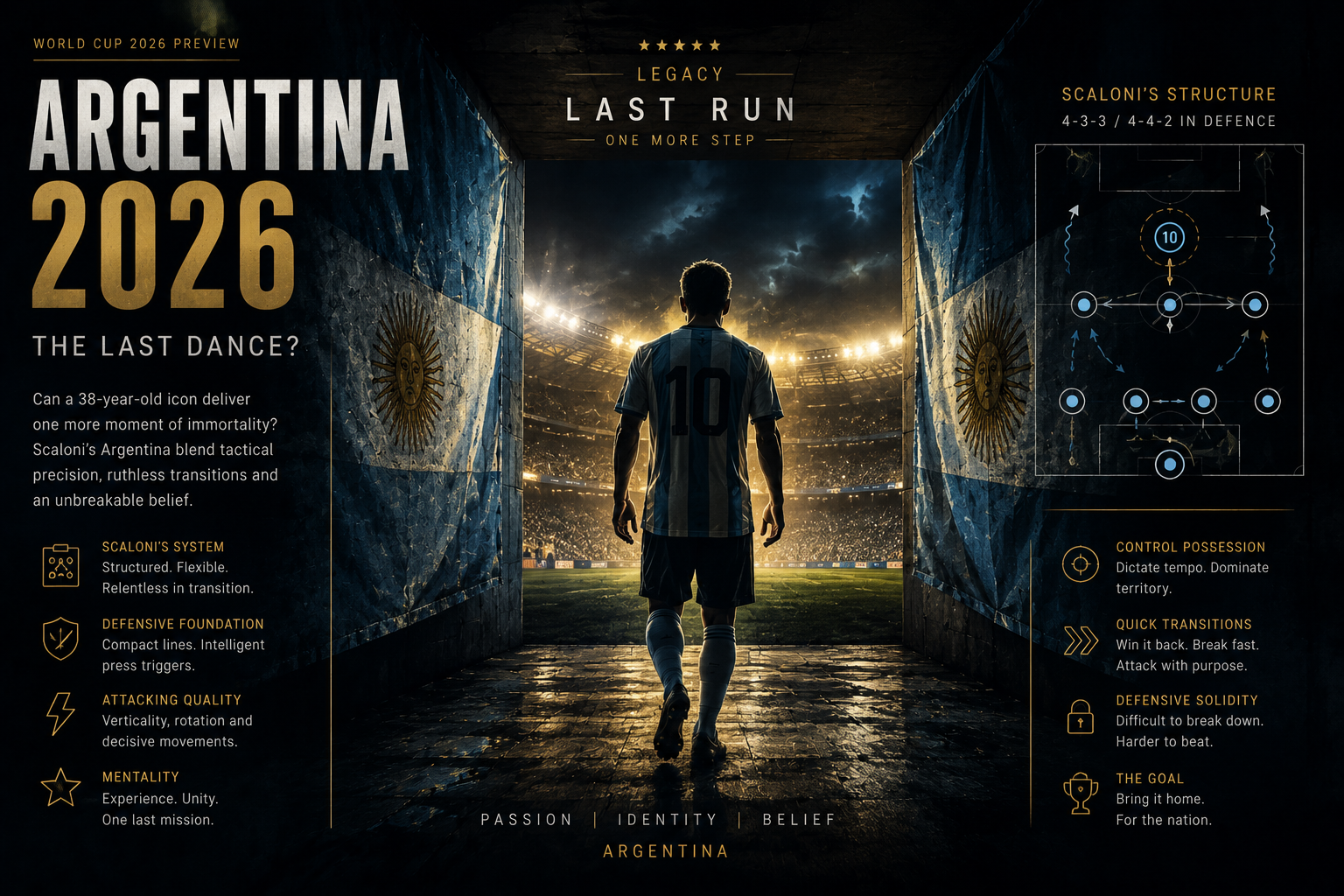
Lionel Messi scored the goal that changed everything in the final in Lusail. The 2022 World Cup final against France — the greatest final played in the tournament’s history by the measure of drama, of quality, of the competing forces of individual brilliance and collective cohesion across one hundred and twenty minutes and a penalty shootout — was decided by him and by the goalkeeper who stopped Kingsley Coman’s penalty and by the specific, irreplaceable quality of a team that had been built precisely to carry Messi to what the sport had been denying him for two decades.
He has been thirty-eight years old since the twenty-fourth of June. He is playing for Inter Miami in MLS, the city he chose for the last chapter of a club career that covered six seasons at Barcelona, a year at PSG and now this American epilogue. He trained this morning in Florida. He will fly to the training camp. He will be at the World Cup.
Argentina are defending champions, managed by Lionel Scaloni for the fourth consecutive major tournament, and they face the specific pressure that attaches to defending champions: the expectation not just to be good but to be as transcendent as they were in 2022, to replicate a version of what Messi produced in Qatar that may not be physically replicable at thirty-eight.
The preliminary squad has been cut to thirty-five. The final twenty-six is expected in the next forty-eight hours. What is certain is that Messi is going, Lautaro Martínez is going, Julián Álvarez is going, and Emiliano Martínez — the goalkeeper who made the penalty save that changed the 2022 final — is going.
What is also certain is that Ángel Di María is not. Five other members of the 2022 champion squad have also been left out. Time, Scaloni has decided, has moved on.
The Group
Argentina are in Group J alongside Austria, Algeria and Jordan. By the standards of what Argentina bring to any tournament, this is a manageable group. Austria, with David Alaba recovered from a second serious knee injury and a squad built around a pressing intensity that Ralf Rangnick has installed, will be difficult — they are a technically organised European team who qualified comfortably and will defend with discipline. Algeria, with Riyad Mahrez and a generation of talented forwards, represent the most technically gifted opponent in the group. Jordan qualified through the AFC playoffs in a story that resonates across the region.
Argentina should advance from Group J with minimal drama. The real tournament begins in the knockout rounds, where Scaloni’s team will face the kind of opponents against whom the quality of Messi’s contribution — and whether he can sustain it for ninety minutes repeatedly across consecutive weeks — will be the most discussed question in the press boxes.
Messi at Thirty-Eight
Every word written about this squad ultimately circles back to the same fact: Lionel Messi is thirty-eight years old and is at a World Cup. He retired from Argentine football immediately after 2022 and then rescinded his retirement. He is playing.
The question is not whether he should be there. If you have watched Messi play this season, even in MLS, you know that what he does with the ball in a ten-metre radius remains categorically better than what anyone else does — the first touch that settles the ball exactly where the next movement requires it, the pass that arrives at angles that require the receiver to adjust their run rather than the ball adjusting to the run, the dribble from standing that defeats pressure through body position before the ball even moves. These are not diminished gifts. They are present.
The question is what thirty-eight means across ninety minutes, four or five times in five weeks, against opponents who are pressing at intensity and making the physical demands that international knockout football makes on a body that has now been playing professional football for twenty-two years.
Scaloni has managed Messi’s minutes carefully through the qualifying campaign and through the Copa América, using him from the start in crucial matches and rotating in matches that don’t require it. The same template will apply in the group stage. What happens when the knockout rounds demand full Messi, ninety minutes at a time, at full function — that is the question the tournament will answer on Argentina’s behalf.
The Di María Absence
Ángel Di María was present for the 2022 final. He scored in it — the goal that made it 2-0 with minutes remaining before France’s extraordinary comeback. He was the player whose quality was most unexpected in that final, the thirty-four-year-old who summoned the best football of his tournament life on the biggest night.
He is thirty-eight now, and not in this squad. Scaloni’s decision to leave him out — along with five other 2022 World Cup winners — is the clearest statement he has made about the transition that is underway. Argentina still have Messi, they still have the champions’ core, but the squad that assembles in the United States is building toward what Argentina will look like in 2030 as much as it is trying to defend what they won in 2022.
The players taking those spots: Alejandro Garnacho, twenty-two, at Chelsea. Franco Mastantuono, sixteen, Real Madrid’s latest prodigy. Claudio Echeverri, the Girona forward who has announced himself across the 2025-26 La Liga season. These players represent the investment in the future. Di María’s absence represents the recognition that the future has arrived.
Lautaro and Julián
Lautaro Martínez scored seventeen goals in thirty Serie A appearances for Inter Milan in 2025-26, finishing as the league’s top scorer. He is twenty-eight years old. He is in the form of his career. His partnership with Julián Álvarez — the combination that generated so much of Argentina’s attacking dynamism in 2022 — returns as the principal option behind Messi in Scaloni’s system.
Álvarez, at Atlético Madrid under Diego Simeone, has developed into one of the most complete centre-forwards in European football — a player who presses from the front with extraordinary intensity, who finishes from positions that more conventional strikers wouldn’t reach, who understands the geometry of Scaloni’s attacking system better than almost anyone else in the squad. His season in the Champions League semi-final, where Atlético defeated Barcelona 3-2 across two legs, confirmed what Argentine supporters already knew.
The combination of Messi creating — dropping to receive, finding the pass before the press can close — with Álvarez and Lautaro running in behind, is the most dangerous attacking sequence that Argentina own. It is also the sequence that Scaloni has been running since 2019. The only variable is Messi’s age and whether the tempo at which he operates it has changed.
Emiliano Martínez
Emiliano Martínez won the penalty save that defined the 2022 final. He received a yellow card from the referee for celebrations that football’s governing bodies deemed inappropriate. He wept, and waved his gloves at the crowd, and became the hero of a nation that had waited thirty-six years for that specific moment.
He is now thirty-four. His season at Aston Villa — who this year won the Europa League under Unai Emery, with Martínez as the first goalkeeper in the club’s history to lift a European trophy — has confirmed that his form has not declined. He is one of the best shot-stoppers in the world, a goalkeeper who thrives in the specific pressure of high-stakes moments. He will be between the posts for every match Argentina play.
The Defensive Picture
The central defensive partnership of Cristian Romero and Lisandro Martínez represents one of the most physical and competitive defensive combinations in international football. Romero, at Tottenham, is aggressive and aerial and occasionally reckless in ways that produce yellow cards and defensive errors but also the kind of leadership that defensive partnerships need in tournament football. Lisandro Martínez, at Manchester United, provides the technical complement — a left-footed centre-back whose ability to bring the ball out from the back and find the switch pass gives Argentina’s build-up something the 2022 squad didn’t always have.
Rodrigo De Paul, at Inter Miami alongside Messi, and Alexis Mac Allister, at Liverpool, provide the midfield infrastructure — De Paul’s relentless pressing and physical intensity, Mac Allister’s technical contribution and creative depth giving Argentina a midfield that is less celebrated internationally than France’s or Spain’s but more coherent in its collective function.
Enzo Fernández, at Chelsea, adds the creative option from midfield depth — a player capable of breaking lines with his passing and contributing directly to goals from central positions.
The Case For and Against
The case for Argentina defending the title runs: Messi is still Messi, Emiliano Martínez is still the best tournament goalkeeper in the world, Scaloni has managed this squad better and longer than any other manager in this tournament has managed theirs, and defending champions are always underestimated in their ability to find the same quality of performance twice.
The case against runs: Messi is thirty-eight, Di María is gone, the attacking freshness that gave 2022 its specific quality has partially aged, and the opponents Argentina will face in the knockout rounds — Brazil, France, Spain, Germany — are all in excellent collective form. Defending a World Cup is, historically, among the most difficult things in sport.
How Argentina Win It
They win it if Messi produces thirty minutes of his best football in each of the knockout matches — thirty minutes is enough, when distributed across a full game, to decide any match. They win it if Álvarez and Lautaro contribute the goals that tournament football requires from the second and third names on the teamsheet, releasing Messi from the obligation to be the direct scorer as well as the creator. They win it if Emiliano Martínez saves a penalty in the quarter-final that Argentina should not have survived.
They lose it if the physical demands of a first- or second-round knockout match expose what thirty-eight means at full intensity, and Messi comes off at sixty minutes having been unable to sustain what the match requires, and the substitute who replaces him is not quite enough.
The Verdict
Argentina are among the five or six teams who could realistically win this tournament. They are not, by the balance of form and squad freshness, the clear favourite — that is Spain. They are, by the specific weight of their tournament experience and by the specific quality of Messi’s late-career football, more dangerous than anyone could measure with statistics alone.
The question that every football conversation about Argentina returns to in this tournament is: can Messi do it twice? The 2022 answer — yes — was the most complete sporting answer he has ever given. Whether the body that gave that answer at thirty-five can give a version of it at thirty-eight is a question that belongs not to tactics or squad depth but to the physics of what the human body sustains across a career.
He will be there. He will play. He will create moments that no other thirty-eight-year-old on earth could create. Whether it will be enough — whether the thirty-eight comes at a cost that the final days of a long tournament will reveal — is what we are here to find out.