In the summer of 2008, Arjen Robben joined Real Madrid having already built a reputation at Chelsea as a winger who simply refused to stay wide. His instinct, whenever he received the ball on the right flank, was to cut inside onto his stronger left foot — not to beat a defender and cross, as wingers had done for a century, but to arrive in central territory with the goal directly ahead and the left foot cocked and ready.
Madrid’s coaching staff found this problematic. Traditional wingers serve crosses. They stretch defences horizontally. They pull full-backs wide, create the space between the lines that second strikers exploit, and deliver from the byline. Robben did not want to deliver from the byline. He wanted to be in the box, facing the goalkeeper, left foot aimed at the corner. For the coaches managing him, this was a character trait to be managed, a footballing selfishness to be structured around as best as possible.
Seven years later, Jürgen Klopp signed Mohamed Salah and did something Robben’s managers at Madrid never quite managed: he built an entire attacking system around that same instinct, recognised it not as an idiosyncrasy to be accommodated but as the most devastatingly efficient attacking mechanism in modern football, and engineered a team whose every positional detail — the spacing between lines, the starting positions of the full-backs, the pressing triggers for the strikers — made Salah’s cut inside as dangerous as it could possibly be.
Liverpool won the Premier League. They won the Champions League. Salah became arguably the most consistent goalscorer in England for a sustained period. And the pattern was not Salah’s alone — by then, every elite attacking team in Europe was running some version of the same idea. Sadio Mané on the left. Leroy Sané on the left at Bayern. Serge Gnabry on the right. Rafael Leão at Milan. Lamine Yamal at Barcelona. Marcus Rashford at his best at Manchester United. All of them: a dominant foot on the opposite flank, and a movement inward onto it.
The inverted winger is now the dominant attacking pattern in elite football, has been for fifteen years, and shows no sign of receding. This is the complete account of what it is — the geometry that makes it work, the history of how it evolved, the specific tactical problems it poses, the ways teams have tried and mostly failed to defend it, and why it will continue to shape the game for the foreseeable future.
What an Inverted Winger Actually Is
The definition is cleaner than the concept sometimes appears: an inverted winger is a wide attacker who plays on the opposite flank to their stronger foot.
A right-footed winger on the left. A left-footed winger on the right.
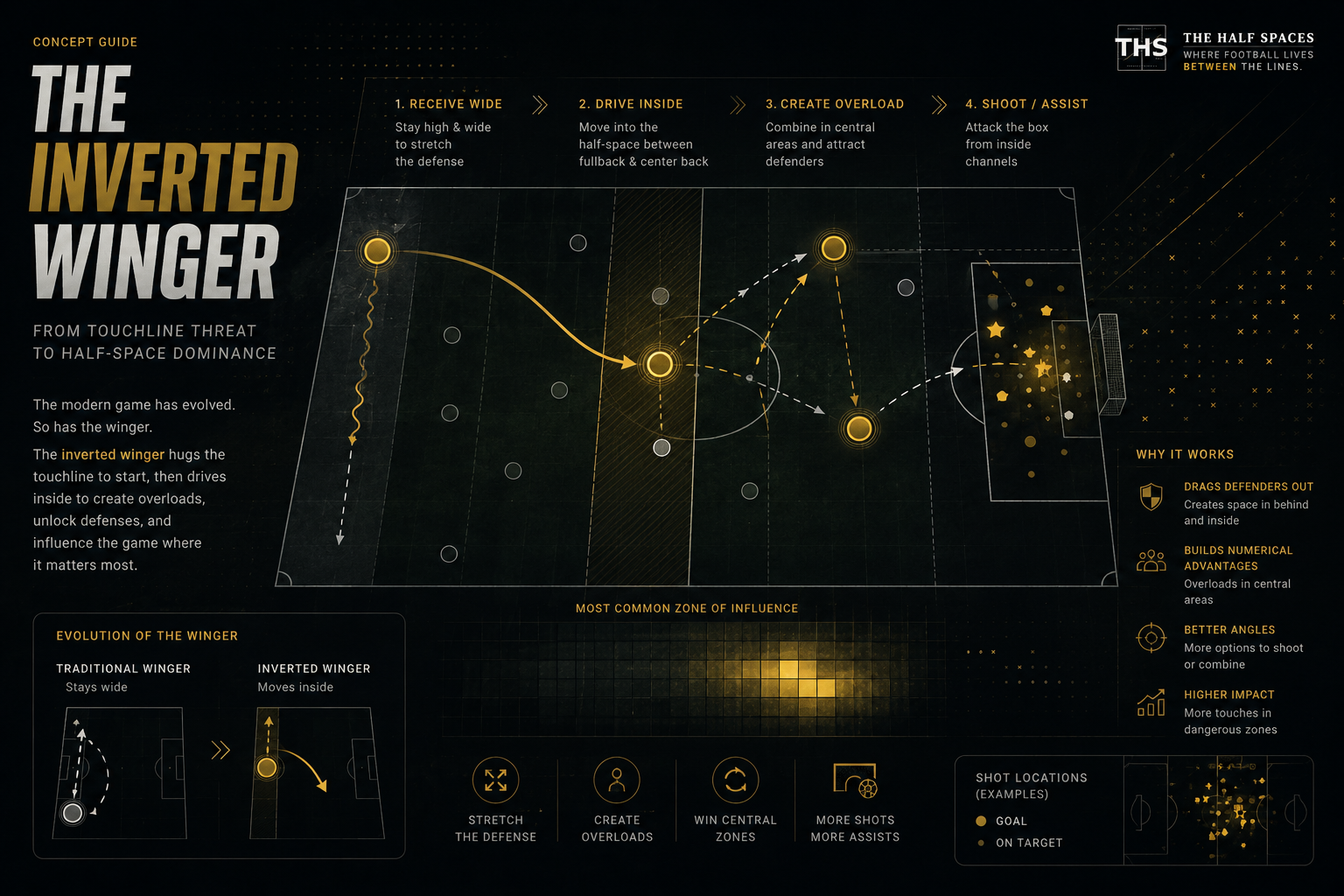
The word “inverted” describes the direction of primary movement. A conventional wide player moves outward — toward the touchline — to receive possession, and delivers the ball into the box from there. An inverted winger moves inward — toward the centre of the pitch — to receive possession, and from that position shoots, plays a through-ball into the penalty area, or combines in the space between the full-back and the centre-back, the zone football analysts call the half-space.
The consequences of this movement are geometrical before they are technical. When a winger drifts inside, they carry the attacking threat into the centre. Their dominant foot — already loaded and ready — points at the goal. The shot from this position is one of the most common in modern elite football: the player cuts in from the flank, arrives twelve to eighteen yards from goal at a slight angle, and drives the ball into the far corner with the stronger foot. It is not especially creative. It does not require exceptional dribbling. It is repeatable, efficient, and hard to stop even when every defender on the pitch knows it is coming.
Because that is the other element of the geometry: the inverted winger does not need to surprise anyone. The full-back knows the winger is going to cut inside. The central midfielder tracking back knows. The centre-back drifting across knows. Every defender has been told in every pre-match meeting. None of them can stop it cleanly.
The reason is that stopping the cut inside creates a different problem. If the full-back follows the winger inward, the flank behind them is vacated — available for the attacking full-back or the overlapping midfielder to exploit. If the central midfielder tracks the run instead, they are pulled wide and their defensive shape is broken. If the centre-back steps out, the backline is asymmetric and the space behind the stepping defender is exposed for a runner to target. Every defensive adjustment to the cut inside creates a secondary problem. The winger is not just dangerous for the shot they are likely to take. They are dangerous because of what their movement forces the defensive structure to do.
This is the fundamental arithmetic of the inverted winger. Defending it correctly requires three things to happen simultaneously: the full-back must hold position, the central midfielder must track the run, and the centre-back must not be drawn. Coordinating three players in different defensive lines across ninety minutes, with a mobile and rapid attacker forcing the pace, is far harder than it sounds. When the coordination fails — even briefly — the inverted winger is in. And they do not waste those moments.
The Geometry: How the Cut Inside Creates Space
To understand why the inverted winger is so structurally important, it helps to consider what a traditional wide player’s movement produces compared to what an inverted winger’s movement produces.
A conventional right winger pushes the left full-back outward. Their threat is along the touchline. The full-back tracks them wide, and in doing so, the entire defensive shape shifts slightly to the right. This is useful — it creates space on the opposite flank for the left winger — but the ball-side defensive coverage remains intact. The winger is moving into space, but that space is far from goal, and the cross they eventually deliver must travel through the most congested area of the pitch: the penalty area crowded with defenders who have had time to track back and organise.
Now consider what happens when the left-footed right winger cuts inside. The full-back’s choice is immediately more complex. Following them inside means abandoning the flank. But staying on the flank means the winger arrives in the half-space between full-back and centre-back with no cover. The movement has forced a decision. And the ball-side defensive coverage is not intact — it has been pulled inward, creating the same wide space the winger vacated, but now it can be exploited by the full-back arriving in overlap.
This is why the inverted winger pairs so naturally with an attacking full-back. The two are not competing for the same space — they are complementary. The winger goes inside; the full-back goes outside. Between them, they occupy two zones simultaneously. The defence, which must track both, is stretched horizontally across the flank in a way it cannot be when a conventional winger and a conventional full-back both hug the touchline.
Trent Alexander-Arnold was for several seasons one of the most statistically productive attacking full-backs in the world. His output in terms of chances created and assists was remarkable for a defender. The structural reason for this is Mo Salah: Alexander-Arnold’s entire attacking contribution was made possible by Salah’s willingness to move inside and vacate the right channel, freeing Alexander-Arnold to push forward into it. The two together operated as a single attacking unit using two zones. Separately, each would have been far less effective.
Historical Roots: Before the Role Had a Name
The inverted winger did not emerge fully formed in the 2000s. Its roots go back considerably further, though the earlier practitioners were not described in those terms.
Garrincha played on the right wing for Brazil in 1958 and 1962 and was, in any fair telling, the best player at both tournaments. His physical movement was not the smooth diagonal drift of the modern inverted winger — Garrincha was an explosive dribbler, bowed legs and unpredictable change of direction, who could beat defenders either way. But his instinct was consistently to move inward. He did not cross from the byline. He pulled inside, drew defenders, created space for his teammates, and occasionally scored himself from positions no conventional winger would reach. The impulse — beat your man and move toward goal rather than toward the touchline — was the same impulse that drives the modern role.
The European precursor is found in the Dutch concept of positional fluidity that Rinus Michels developed at Ajax and that Johan Cruyff embodied throughout his career. Cruyff moved across the pitch horizontally in ways that made any fixed positional assignment irrelevant. He occupied right flank, centre, and left flank in the same passage of play, depending on where the space was. But Cruyff’s fluidity was collective — the Ajax system was designed for every outfield player to occupy every zone, and no single player was assigned to invert from a particular flank. It was a precursor to the inverted winger’s logic without being the thing itself.
In England, Stanley Matthews and then Tom Finney were celebrated as the greatest wingers of the postwar era. Both stayed wide. Matthews in particular was famous for the touchline dribble, the cross to the penalty spot, the conventional wide delivery. The England of that era had no conceptual framework for a winger who moved inside.
The turning point in European football is usually located in the early 1990s, when a number of forwards began to be deployed in positions that violated the conventional wide assignment. Gianfranco Zola at Chelsea, Eric Cantona at Manchester United — not wingers exactly, but players who operated in the space between conventional positions, who came inside to receive possession and turned to face defenders rather than the touchline. They were not inverted wingers by the modern definition but they were indicators that coaches were beginning to recognise the value of the inside position.
Arjen Robben and the Blueprint
Arjen Robben is the most important figure in the history of the inverted winger as a codified role. Not because he was necessarily the most talented inverted winger who ever played, but because he was the clearest and most persistent advocate of the movement before anyone had a name for it — and because his career traced the journey of the role from tolerated individual tendency to structural positional principle.
At PSV Eindhoven in the early 2000s, Robben was already cutting inside from the right onto his left foot. His pace was extraordinary and his balance when changing direction was among the best of his generation, but the movement itself was simple: receive wide, drive inside, shoot. PSV accommodated it. They were not building a tactical system around it — they were allowing a talented player to do what he did best.
At Chelsea from 2004 to 2006, José Mourinho tried to channel it. Chelsea’s 4-3-3 put Robben on the right with Damien Duff on the left, and the structural requirement was that one of them stay wide while the other came inside. More often than not, Duff stayed wide and Robben came in. Mourinho’s system was not designed for two inverted wingers; it was designed for one. But the half-inverted arrangement worked well enough that Chelsea won the Premier League twice.
At Real Madrid from 2007, the coaches found Robben’s tendency more difficult to accommodate. Madrid’s system expected conventional width from their wide players. Robben refused it, partially by temperament and partially by tactical inclination. He wanted the goal in front of him. He wanted the left foot ready. He was never comfortable delivering crosses and he barely attempted them. Madrid sold him to Bayern Munich in 2009, a move that would turn out to be one of the most significant transfers in European football — not because of Robben’s individual output, which was extraordinary, but because of what Bayern’s coaches eventually built around him.
Under Louis van Gaal in 2009-10 and then more systematically under Jupp Heynckes from 2011, Bayern designed their attacking shape partly around Robben’s right-to-left diagonal. They placed Franck Ribéry on the left as a mirror — a right-footed player on the left, cutting inside onto his right. The two inverted wingers were explicit. They were named. They were the structural basis of the team. And in 2013, Bayern won the Champions League using a system in which the cutting movement of Robben and Ribéry was the primary attacking mechanism.
The 4-2 win over Barcelona in the 2013 semifinal second leg is one of the definitive demonstrations of the inverted winger done right. Ribéry on the left cut inside repeatedly onto his right foot, leaving Jordi Alba isolated and repeatedly bypassed. Robben on the right did the same to Jordi Alba’s opposite number. Barcelona’s pressing system was undone not by pace alone but by the positioning logic the two wide players imposed — the full-backs were pulled wide to track them, and Bayern’s central spaces opened accordingly.
Pep Guardiola arrived at Bayern in 2013, already familiar with the inverted winger concept from his Barcelona years. He had deployed Messi as a false nine, which is in some ways a structural cousin of the inverted winger — a player occupying a position nominally wide or central but always moving toward the space where defenders are absent. At Bayern, Guardiola took the Robben-Ribéry blueprint and made it more positionally sophisticated. He told his wide players to hold slightly narrower starting positions — not wide on the touchline but already inside, so the cut was shorter and the arrival in the central zone was faster. The full-backs were explicitly instructed to push up, because the wingers were explicitly not occupying the flank.
Why It Works: The Three Structural Advantages
The inverted winger has persisted at the highest level of football for fifteen years because it provides three structural advantages simultaneously — not one, not two, but three, which is why defeating it is so much harder than it looks.
The first is the direct threat. The inverted winger arrives in central attacking territory with their dominant foot facing the goal. The shot from twelve to eighteen yards, arriving from a diagonal, driven into the far corner with the stronger foot — this is one of the highest-percentage attacking actions in football. It is not spectacular or creative, but it is extremely difficult to stop. The goalkeeper must cover a wider angle. The defenders blocking the shot are doing so from positions they have been pulled into from elsewhere. The ball is struck cleanly, with conviction, by a player who has practised this exact movement thousands of times. Robben scored version of this same goal throughout his career. Salah still scores it. Lamine Yamal scored it against France at Euro 2024 when he was sixteen years old, from the right flank onto his left foot, from the same diagonal angle, into the same far corner.
The second is the space it creates behind the full-back. When the winger cuts inside, the full-back’s defensive responsibility splits. They must track the ball-carrier into central territory or hold their position and allow the winger to arrive uncontested in a dangerous zone. If they track, the channel behind them opens. The attacking full-back — who in modern football is increasingly expected to function as a wide midfielder rather than a defensive specialist — pushes into that channel, receives the ball late in the move, and has the penalty area on their strong side. This overlap is not incidental to the inverted winger system. It is the system’s second mechanism, the complementary action that means a defensive team cannot simply choose to track the winger inside without conceding the equivalent danger from the opposite direction.
The third is the compression of the defensive shape. Two inverted wingers create a narrower, more compact defensive structure than two conventional wingers, because their starting positions are closer to the centre of the pitch. This means the team has more players in the zones where pressing is most productive — the central corridors and the half-spaces — which makes the team’s defensive organisation in transition more coherent. Guardiola’s teams press from wide positions as well as central ones, but the inverted wingers’ natural positioning means that when possession is lost, the wide players are already close enough to the central zones to join the press quickly. This is one of the reasons gegenpressing and the inverted winger coexist so naturally: they are structurally compatible ideas that reinforce each other.
Mohamed Salah and the Liverpool Engineering
Mohamed Salah arrived at Liverpool in 2017 as a player who had been notably unsuccessful at Chelsea under Mourinho, loaned out and eventually sold. His time at Roma had been productive but not transformative. What Liverpool and Klopp recognised was that Salah’s single most important quality — his cutting movement from the right onto his left foot, executed at extraordinary pace — had never been built around.
Klopp built around it entirely.
The Liverpool 4-3-3 in its peak form from 2018 to 2020 was a machine designed partly to maximise Salah’s cut inside. Alexander-Arnold at right-back was, structurally, as much a creative midfielder as a defender — his passing range, his set-piece delivery, his forward runs were all made possible by Salah’s guarantee that the right channel would be vacated when Alexander-Arnold wanted to move into it. The right-back’s attacking contributions were not an accident or an individual player’s idiosyncrasy. They were the designed consequence of placing an inverted winger ahead of them.
On the opposite flank, Sadio Mané was a left-footed player on the left wing — a conventional positioning choice that might seem to contradict the inverted-winger logic. But Mané was also capable of cutting inside, and the combination of Mané’s inside-out movement with Salah’s inside movement meant Liverpool’s attack came from multiple diagonal angles simultaneously. Defenders never had a clean assignment.
Roberto Firmino as the centre-forward completed the structure. His role as a false nine meant he dropped deep to receive, pulling centre-backs out of position and creating the space that Salah’s arriving runs could exploit. The system was integrated: Salah’s cut created space for Alexander-Arnold; Firmino’s drop created space for Salah’s runs in behind; and Mané’s threat from the opposite flank prevented defensive resources from concentrating only on the right side.
Salah’s goalscoring record in this period — 32 goals in his debut Premier League season, which set the record at the time; 22 in the pandemic-interrupted year; 23 in 2021-22 — was the direct product of this structural engineering. He did not score those goals alone. He scored them because every positional decision around him was made to maximise the value of the one thing he does best.
What is remarkable is how persistent the pattern has been. A decade into his elite career, Salah is still cutting inside from the right. The movement has not changed. Defenders still know it is coming. And he still scores from it, because the structural conditions that make it effective — the space behind the full-back, the arriving Alexander-Arnold, the compressed central zone that makes his shot harder to block — are still present every time he receives the ball on the right flank.
Leroy Sané, Serge Gnabry, and the Guardiola Method
Guardiola’s time at Manchester City from 2016 onward was partly a continuing experiment in how to maximise the inverted winger’s structural advantages. He tried multiple versions of the role — Sterling at wide-left cutting in right-footed, Sané at wide-left cutting in right-footed, Bernardo Silva at wide-right, Gabriel Jesus drifting from wide positions, eventually Grealish at wide-left.
But the clearest expression of the Guardiola inverted-winger system was at Bayern Munich in 2013-16, using Robben on the right and Sané’s predecessor, Thomas Müller in a slightly different role, alongside players like Kingsley Coman and Douglas Costa. Guardiola’s positional play instruction was consistent: the wide players should not wait on the touchline. They should begin their movement inward from kick-off, holding narrow starting positions that invited the full-back to push even further up the pitch, creating a two-versus-one situation on each flank where the full-back and the winger both threatened the area the defensive full-back was trying to cover.
This positional discipline — starting inside rather than wide, already positioning for the cut rather than initiating it — is the difference between the Guardiola interpretation of the inverted winger and earlier versions of the role. Robben at Chelsea cut inside reactively, in response to what the game offered him. Guardiola’s wingers did it structurally, from a predetermined starting position, on the first touch if the situation allowed it.
Serge Gnabry at Bayern in the late Guardiola era and the post-Guardiola era demonstrated the role at its most clinical. A right-footed left winger in some interpretations, a right-footed right winger cutting inside in others, Gnabry was capable of the inverted movement from either flank. His goal output — particularly in European competition, where he scored four goals at Tottenham in a single Champions League group stage game in 2019 — was built almost entirely on the movement: receive the ball in a wide position, drive inside, shoot or set up. He was not prolific because of individual brilliance. He was prolific because the movement he repeated was structurally efficient.
Rafael Leão and the Physical Variant
Rafael Leão at AC Milan represents a variant of the inverted winger that adds an important dimension: the genuine dual threat.
Most inverted wingers are predictable in one sense — opponents know they are going to cut inside, and the question is only how to manage what follows. Leão has complicated this by being sufficiently rapid along the outside line that defenders genuinely cannot commit to tracking him inside. His pace in a straight sprint is among the highest recorded in Serie A, and he can accelerate from standing to full speed in fewer strides than most players at his level. This means that when a full-back holds position to protect the space behind them, Leão simply goes around the outside instead — beats the full-back on the outside line, arrives at the byline, and cuts back or crosses.
A defender tracking an orthodox inverted winger is making a choice between two bad outcomes: follow inside and give up the flank, or hold and give up the central zone. When the winger can only go inside, the defender knows which bad outcome to accept — the direct shot from the inverted cut is dangerous but it is one-dimensional. Against Leão, both outcomes are genuinely terrible. He is as dangerous on the outside as the inside, which means the full-back has no acceptable positioning.
Federico Chiesa, when fit, presents a similar problem from the right flank. A right-footed player who can operate effectively on either wing, Chiesa’s direct speed and his ability to choose between cutting inside and going past on the outside makes him one of the most technically difficult wingers to defend in Europe when he is at his best.
The Italian school of the inverted winger tends toward this more physical, more explosive interpretation. Where the German-influenced version is positional — the winger holds a narrow starting position and triggers the cut from a set point — the Italian version is more reactive, more dependent on individual skill and speed to create the moment. Both are effective. They reflect different coaching traditions rather than different tactical logic.
Lamine Yamal and the Next Generation
Lamine Yamal was sixteen years old when he played for Spain in the Euro 2024 final. He started on the right flank, left-footed. He cut inside from the right throughout the tournament with the confidence and directness of a player a decade his senior. His goal against France in the semifinal — receiving from a cutback just outside the penalty area, left foot, far corner — was the inverted winger’s defining action, scored by a teenager who appeared to feel no pressure whatsoever.
Yamal represents something important about the inverted winger’s future: the role has become so fundamental to attacking football that the best young players are being specifically developed into it from a very early age. Barcelona’s academy — La Masia — produces players for specific positional roles in Barça’s system, and the right-flank inverted position is now as much a product of that academy’s training methodology as the deep-lying playmaker or the pressing striker.
The next generation of inverted wingers — Yamal, Endrick exploring wide positions at Real Madrid, Alejandro Garnacho at Manchester United — all play with the same instinct. Cut inside. Arrive on the stronger foot. Shoot or play. The movement is the same regardless of nationality, club, or coach. It has become, in effect, the default attacking action for a wide forward at elite level, as natural and expected as a striker turning and shooting when they receive in the box.
How Teams Defend the Inverted Winger
Every coach in elite football understands what the inverted winger will try to do. Defending it effectively, despite that understanding, remains one of the most persistent problems in the sport.
The theoretical defensive solution is the pincer. The full-back holds position to protect the flank — preventing the overlap scenario. A central midfielder or a pressing midfielder tracks the winger’s run inside — preventing the cut-inside shot. The centre-back stays home — preventing the space behind the tracking centre-back from being exploited. All three actions must happen simultaneously, by three players in different defensive lines, against a rapid attacker who is making their movement at full pace.
In practice, the pincer breaks because the required coordination is too precise. The full-back and the central midfielder must communicate in real time about who is tracking the winger. The central midfielder must recognise the trigger for their tracking run before the winger has received the ball. The centre-back must hold their position even when the winger is arriving in their zone at speed. A single moment of miscommunication — or a single moment of the winger outpacing the tracker — leaves the inverted winger free in the central channel with the goal in front of them.
Some teams attempt a different approach: the extremely high defensive line, which shortens the pitch so that the inverted winger receives in a more congested area and has less time and space to set up their shot. This works to a limited degree — less space does mean less time — but the movement itself creates the zone regardless of the defensive line’s height. The half-space between full-back and centre-back exists whether the line is at the halfway line or at the edge of the penalty area. The structural problem the inverted winger poses cannot be solved by simply moving the defensive block higher.
The most successful teams at limiting the inverted winger’s effectiveness are those who press high enough that the wide player rarely receives the ball in their preferred zone with any time to set up the movement. Disrupting the ball delivery to the winger — preventing the pass that lets them receive and turn — is more effective than trying to defend the movement itself. But this requires a coherent pressing system of its own, one that carries its own risks, and it does not eliminate the threat: it delays it.
What managers consistently find is that the best they can do against a genuinely dangerous inverted winger is limit the number of times the movement happens, and accept that when it does happen, some proportion of those occasions will produce dangerous situations regardless of how good their defensive structure is. Robben at his best could not be stopped — he could be reduced. Salah at his best could not be stopped — he could be managed. The acceptance that the threat cannot be eliminated is itself part of the psychological burden the inverted winger imposes.
The Inverted Winger and High Pressing Systems
The relationship between the inverted winger and high pressing is one of the most underappreciated tactical interactions in modern football.
High pressing systems — gegenpressing particularly — require the pressing team’s wide players to begin their pressing runs from positions close enough to the ball-recovery zone that they can arrive quickly when possession is lost. A wide player starting on the touchline is too far from the central pressing triggers to contribute effectively to the press in the first second or two after the team loses the ball.
An inverted winger starts much closer to the centre. Their narrower beginning position means that when the press is triggered, they are already in or near the zone where they need to be. They can join the press faster. They can cover the passing lanes the opposition full-back is looking to use. They can trap the ball against the touchline — forcing the opposition to play into the press rather than escaping it.
This is why the teams that press hardest — Klopp’s Liverpool, Guardiola’s City in certain seasons, Thomas Tuchel’s teams — tend also to use inverted wingers or players who at least begin in narrow wide positions. The defensive function of the wide player’s starting position is as significant as the attacking function. Both work in the same direction: start narrow, function effectively in two phases, contribute to both attack and press without needing to be replaced when possession changes.
The rest defence concept adds another layer. Inverted wingers who have moved inside during attacking phases are already positioned to provide defensive cover centrally if the team loses the ball — they do not need to sprint back to cover the centre because they are already in or near it. This reduces the vulnerability to transition attacks that affects teams whose wide players are caught on the touchline when possession turns over.
Inverted Winger vs Traditional Winger: Why Coaches Made the Switch
The question that goes underasked in any discussion of the inverted winger is the one that was obvious in 2005: why would you deliberately put a left-footed player on the right wing? The answer forces a comparison between the two models that explains not just the inverted winger’s rise but the near-extinction of the pure traditional winger at elite level.
A traditional wide player’s primary function is width and delivery. They hug the touchline, stretch the defensive shape horizontally, and cross into the box. This model has the advantage of natural separation — the winger and the striker operate in different zones, preventing congestion — and it provides crossing balls that can be scored from distances and angles that shooting cannot. The traditional winger, done well, creates goals through precision delivery rather than individual finishing.
The problems with this model became apparent as defensive organisation improved. As teams got better at defending crosses — packing the penalty area with bodies, training centre-backs specifically to head crosses defensively, using zonal marking to remove the individual matchup that an in-swinging cross was designed to exploit — the value of the delivery dropped. A crossed ball entering a box defended by six or seven bodies is unlikely to become a goal regardless of its quality. The traditional winger’s primary mechanism became less and less effective as defensive sophistication increased.
The inverted winger solved this by relocating the creation zone. Instead of delivering from the byline into a crowded penalty area, the inverted winger drove to the edge of the box — less crowded, more space, defenders pulled by the cut-inside movement — and either shot themselves or played a pass into the penalty area from a less trafficked angle. The ball entering the box from this position arrived from a different vector than a cross, catching defenders who had organised for the traditional delivery. The low cutback into the box from the half-space, a ball that arrives along the ground at the penalty spot for an arriving midfielder, is one of the most effective modern variants of this — it is the inverted winger’s equivalent of the traditional cross, but arriving from a far more dangerous position.
There is also a pressing dimension to the comparison. Traditional wingers, playing wide on the touchline, are isolated from the central zones where pressing is most productive. When possession is lost, they must sprint across the pitch to join the press. This sprint takes time, and during those seconds, the pressing team is a player short in the central zone. Inverted wingers, by contrast, start and operate in or near those zones, and can contribute to the press immediately after losing possession without needing to cross the width of the pitch first.
The coaches who made the tactical choice to use inverted wingers — Guardiola most consistently, but Klopp, Ancelotti in his more structured periods, Conte in 3-5-2 variants where the wing-backs take conventional width — were not making an aesthetic preference. They were choosing a model that provided more direct goal threat, more pressing efficiency, and a better match for the full-back’s desire to attack. The traditional winger did not disappear because it was unfashionable. It receded because the inverted winger is structurally superior in the game as it is currently played.
Whether a resurgence of the traditional winger is possible depends on whether defences find ways to crowd the half-space sufficiently that the inverted winger’s cut-inside becomes less productive. There are signs of that happening in isolated tactical matchups — a narrow 5-4-1 defensive block can limit the space available for the inverted winger to arrive in — but no team has sustained this successfully enough to shift the broader tactical consensus. The inverted winger remains dominant.
Why the Inverted Winger Persists
The inverted winger has now been the dominant wide attacking pattern in elite football for the better part of fifteen years. It survived tactical evolution, changes in coaching philosophy, defensive adaptations, rule changes, and complete generational turnover in the players performing it. Every year, the role seems to produce new practitioners who reach the same conclusions as their predecessors: the cut inside, the stronger foot, the arrival in the central channel.
The reason is that its effectiveness is structural rather than individual. The inverted winger does not work because Robben was exceptional, or because Salah is exceptional. It works because a right-footed player on the left flank creates a defensive dilemma that cannot be solved without creating another problem. The arithmetic is permanent. As long as defenders have two feet — and they do — the side-foot tracking of an inverted winger’s run creates a vulnerability somewhere. The question is only which vulnerability the defending team chooses to live with.
The game changes around the inverted winger but the role’s core logic does not. Full-backs have become more attacking over the period that the inverted winger has dominated, partly as a response to the space created by the cutting movement. Defensive midfielders have become more mobile, partly because of the tracking responsibility that inverted wingers impose. But neither of these adaptations has reduced the inverted winger’s effectiveness — in some cases they have made it more effective, because a high-attacking full-back arriving into the vacated space is even more dangerous than a conventional overlapping full-back would have been.
The next fifteen years of wide attacking football will be shaped by players who follow the same logic that Robben followed in 2004 at Stamford Bridge, that Messi embodied in that Clásico of 2009, and that Salah has repeated several thousand times over his career at Anfield. Receive wide. Drive inside. Arrive on the stronger foot. Choose between the shot and the pass, and make the choice that the defence has made worst for themselves.
That is the inverted winger. It is the most repeatable, most structurally effective, most persistently dangerous attacking mechanism in modern football. It will remain so for the foreseeable future, because the geometry does not change, and the geometry is everything.