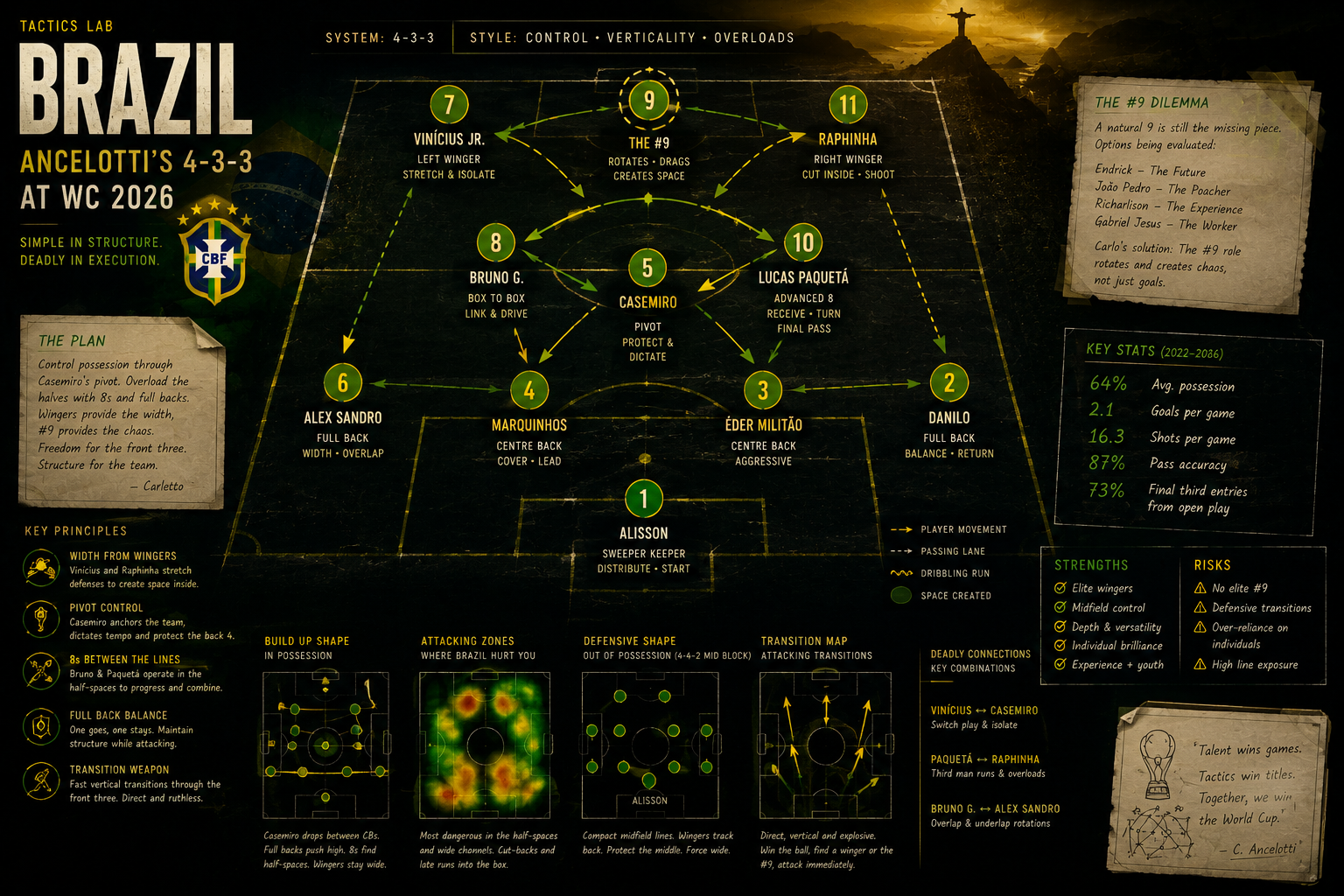
There is a version of the Brazil story at this World Cup that writes itself — the golden generation assembled, the great European manager imported, the five-time champions finally ready to end their 24-year title drought. There is another version, perhaps closer to the truth, that is more complicated and more interesting: a team of extraordinary individuals without a settled formation, a returning legend whose body may no longer sustain what his mind still imagines, and a manager whose genius has always been the confident simplification of enormous complexity. Carlo Ancelotti’s Brazil is both of these things at once. That tension is what makes them compelling.
The appointment itself was seismic. Brazil have never, in the entirety of their football history, appointed a foreign manager for the senior national team. The pride embedded in that fact was not merely ceremonial — it reflected a genuine belief that Brazilian football had its own identity, its own tactical vocabulary, its own understanding of the game that no outsider could fully access or meaningfully improve. When Dorival Júnior’s tenure ended in the wreckage of a 4-1 defeat to Argentina, the CBF made a decision that represented a philosophical break from everything that had come before. They chose pragmatism over continuity. They chose Carlo Ancelotti.
The reaction was not universally warm. Former players, commentators, and supporters who had grown up believing that Brazilian football was something that had to be understood from within questioned whether a man whose coaching career had been built almost exclusively at the summit of European club football could translate his methods to the very different rhythms of international management. Ancelotti, to his credit, did not attempt to claim that he understood Brazil as deeply as its own people did. What he offered instead was something more specific: he knew how to manage elite talent, he knew how to win in high-pressure knockout tournaments, and he had spent the last several years in Madrid building a team around the most dangerous wide forward on the planet. That was, the CBF concluded, sufficient.
The 4-3-3 that Ancelotti has installed at Brazil is the same formation he used through his most successful years at Real Madrid — and the same one, with modifications, that he has carried through every senior appointment of his career. Its logic is elegant in its simplicity. Three genuine forwards who can all create and score. A midfield three with a defined defensive anchor and two players who can both receive and drive forward. Two wide centrebacks with composure in possession. Two attacking fullbacks who provide width when the wingers drift inside. The structure is legible, the roles are clear, and the system’s success depends not on a particularly intricate implementation but on the quality of the individuals placed within it.
This is, it is worth noting, a philosophy that exists in explicit opposition to the dominant tactical trend of the last decade. The most influential coaching minds of the modern era — from Pep Guardiola to Jürgen Klopp to Mikel Arteta — have built their reputations on precise positional systems, carefully choreographed pressing triggers, and complex positional rotations that require months of daily training to internalise. Ancelotti has always viewed this approach with a degree of scepticism that stops just short of disdain. His view, refined over four decades in the game, is that the function of a coaching system is to liberate talented players rather than to constrain them — and that the most dangerous tactical weapon available to any team is a player who is given genuine freedom and backs himself to use it.
At Real Madrid, this produced one of the most successful periods in the club’s already extraordinary history. The question now being asked in Brazil, and in football analysis rooms across the world, is whether the same approach can work on the international stage, where preparation time is measured in days rather than months, where tactical familiarity between players must be established rapidly, and where the opposition’s analysts have weeks to identify and exploit structural patterns. It is a genuine question. The answer, over the next month, will be one of the most fascinating pieces of evidence in the ongoing debate about what international football management actually requires.
Any honest analysis of Brazil’s tactical approach must begin with Vinícius Júnior, because any honest analysis of Ancelotti’s Brazil begins there too. The Real Madrid winger is not merely the team’s best player — he is the reference point around whom everything else in the attacking structure is organised. The left side is his territory, the freedom to roam is his primary instruction, and the system’s attacking output is substantially dependent on what he produces from that space.
At Madrid, Vinícius’s operation on the left has been refined over years of daily work to a level of extraordinary nuance. He understands precisely when to stay wide and receive into feet, when to burst in behind the fullback, when to cut inside onto his right foot and shoot, and when to hold the ball and wait for movement ahead of him. He understands the timing of overlapping fullback runs. He understands when to slow the game and when to accelerate it. These are not instinctive decisions only — they are the product of an enormous number of training repetitions with specific teammates whose movements he knows with near-total precision.
The supply chain for Vinícius at Brazil is different, and that difference matters. At Madrid, the player who most reliably arrived late from central areas into the left channel was Jude Bellingham — an instinctive forward runner with elite timing who understood when the moment to depart was approaching. At Brazil, the midfielder arriving into those areas is Bruno Guimarães. He is a different kind of player: more explicitly a box-to-box midfielder, a more conventional ball carrier, an excellent but less instinctive forward runner than Bellingham. The rhythms of the combination play are slightly different. The maturity of the partnership is lower. This is not a criticism of Bruno Guimarães — it is simply an acknowledgement that the most dangerous version of Vinícius requires a specific kind of support from central areas, and that building that support from scratch in an international preparation camp takes time that Ancelotti has not had.
The diagram above maps the core structure of Vinícius’s left-wing operation as Ancelotti has implemented it. The wide starting position, against which he measures his initial drive inside. The three primary routes from that first movement — the early ball into feet as he drifts into the left half-space, the ball played behind the fullback for a run in behind, or the central hold that invites the overload and creates the third-man option. What it also shows is the critical role of Bruno Guimarães arriving from the right side of the midfield three — not in the diagonal Bellingham position that Madrid fans will recognise, but slightly deeper and slightly later, functioning more as a secondary creator than as a primary forward runner. It is a small adjustment. It may also be consequential.
Then there is Neymar.
The 34-year-old’s selection for this squad is the single most discussed decision of Ancelotti’s tenure and, in a broader sense, one of the most emotionally loaded calls any international manager has made in recent memory. Neymar has been absent from the international stage since the knee surgery that effectively ended his run at PSG. He has returned to Santos — a decision that carries its own enormous emotional weight in Brazilian football — and has played regularly enough in the last several months to convince Ancelotti that he is fit. Whether he is fit enough for the specific demands of tournament football at the highest level is a different question, and it is the one that nobody can answer with certainty until the moment arrives.
Tactically, Neymar in this Brazil setup occupies a position that is simultaneously obvious and fluid. Ancelotti has spoken about using him between the front three and the midfield — a role that might be described as a false wide-right or an elevated ten, depending on the game state. In possession, Neymar finds pockets between the opposition’s midfield and defensive lines, receives in tight spaces with his back to goal, and creates from those positions with a combination of close control, vision, and the ability to draw fouls in dangerous areas that has characterised his game for fifteen years. In the specific territory of set pieces — free kicks won by contact in areas twenty to thirty metres from goal — Neymar remains arguably the most dangerous specialist on earth.
The fitness question is not one that can be dismissed by pointing to his recent Santos form. Brazilian domestic football and knockout World Cup matches against Morocco or Argentina operate at different physical intensities, and Neymar’s reconstructed knee has not been tested at those intensities for more than two years. Ancelotti is known to manage his elite players with particular intelligence — he understands load management, he understands rotation, and he understands how to protect a player whose value lies in moments of quality rather than continuous physical output. If anyone can find the right usage pattern for Neymar at this tournament, it is likely the manager who extended Karim Benzema’s effective career by several years at Madrid. The question is whether there are enough such moments available.
What Neymar’s presence undeniably does is add a dimension of creative unpredictability that the rest of the squad, for all its quality, does not quite replicate. Vinícius is more explosive, Raphinha is more consistent, Bruno Guimarães is more physically complete — but none of them occupies that specific creative territory between the lines with Neymar’s particular combination of technical ability and football intelligence. If he is fit and engaged, Brazil become noticeably harder to defend against. That calculation, ultimately, is why Ancelotti picked him.
The formation diagram clarifies what Ancelotti has assembled in the middle of the pitch, and why the midfield construction may be the most important structural decision he has made. The single pivot is Casemiro. The forward-carrying midfielder is Bruno Guimarães. The third member of the trio — whether it is Lucas Paquetá or Fabinho — completes a midfield that is asked to be both physically robust and technically progressive.
Casemiro’s form at Manchester United this season has invited reasonable debate about whether he remains the force he was in his peak Madrid years. He does not — no player maintains that level indefinitely. But the question about Casemiro for Brazil is not whether he is the player of 2022 but whether he can fulfil the specific, narrower function that Ancelotti’s system asks of him: to sit, to screen, to intercept, to organise the defensive shape, and to distribute simply when he receives. In that reduced but essential role, Casemiro remains highly effective. Behind two elite centrebacks in Marquinhos and Gabriel — both players whose positional intelligence and aerial authority are well established at the highest club level — the Casemiro screen is the first line of structural protection.
Bruno Guimarães is the more important player in possession terms, and it is worth being direct about that. Newcastle’s box-to-box midfielder has spent the last two seasons establishing himself as one of the five or six most complete central midfielders in Europe. He drives with the ball from deep positions — a quality that is genuinely rare for a midfielder asked to also provide defensive cover. He combines quickly in tight spaces, he arrives late into the penalty area with genuine goalscoring threat, and he has the physical capacity to sustain an extremely high work rate across ninety minutes and across successive tournament matches. For a Brazil team that is constructing its attacking moves from central areas, the ability of the second midfielder to carry the ball forward over thirty or forty metres before releasing wide is fundamental to breaking down organised defences. Bruno Guimarães provides that.
The third midfield spot — Paquetá or Fabinho — represents one of the genuine selection decisions that Ancelotti must navigate as the tournament progresses. Paquetá, now back in Brazilian football with Flamengo after his West Ham stay, brings the highest technical ceiling: he can play between the lines, combine in small spaces, and has a natural chemistry with Vinícius and Bruno Guimarães that reflects years of shared international experience. Fabinho brings a more conservative profile — a second defensive midfielder who allows Casemiro to step slightly higher and Guimarães to push further forward. Against Morocco, or in the event that Brazil meet a physically powerful opponent who targets the middle of the pitch directly, Fabinho’s presence may become the preferred solution.
The question that most complicates Brazil’s tactical identity in 2026 is one that receives less attention than the Neymar debate, perhaps because it has no emotionally resonant answer: they do not have a settled, world-class, orthodox centre-forward.
This is not a minor caveat. The number nine in a 4-3-3 is not simply a finisher — the centre-forward in Ancelotti’s preferred system is the reference point around whom the wide forwards organise their runs. Vinícius’s interior cuts are most effective when a central striker is holding a defender’s attention. Raphinha’s diagonal drives from the right become dangerous in combination when the centre-forward creates space by moving away from the ball. Without a convincing central presence, the geometry of Brazil’s attack changes in ways that are difficult to compensate for entirely through the movement of the wide forwards.
Endrick, on loan from Real Madrid at Lyon, is eighteen years old and represents perhaps the most exciting individual attacking talent in world football at his age. His link play for a teenage centre-forward is extraordinary, his composure in front of goal has been demonstrated at European club level, and his sheer physical authority in the box — unusual at his age — gives him the capacity to compete against experienced international defenders. But eighteen is eighteen, and the centre-forward position in a World Cup is one of the most exposed and demanding on the pitch. Starting him in the opening group game against Morocco, against a physically intense defensive unit, would represent a significant gamble.
Matheus Cunha, now at Manchester United after his successful move from Wolves, is a different kind of option. He is direct, he is physically combative, he creates his own space through movement and aggression rather than purely technical refinement, and he can hold the ball and bring others into play even under pressure. His goal record at club level in the last two seasons has been highly respectable. He is not the most technically gifted centre-forward Brazil has produced — to describe him as such would be generous to the point of misleading — but he is reliable, he runs behind, and he does not complicate the structure around him.
Martinelli, the Arsenal forward, sits slightly outside the orthodox nine profile and is more naturally deployed on the left. He has the capacity to play centrally in a pinch, and his pressing energy and direct running give him a distinctive profile, but using him as the primary nine asks him to do things that are not quite his natural strengths.
The most genuinely interesting possibility, one that Ancelotti has reportedly considered, is a false nine structure in which Vinícius and Raphinha move inside and Neymar drifts into the central spaces from a nominally wide starting position. This would give Brazil an extremely mobile, technically exceptional attacking unit without a fixed reference point, sacrificing the security of a holding presence for the creative chaos of three players capable of occupying any position across the front line simultaneously. It is a high-ceiling, high-risk approach that would demand significant opposition defensive preparation and might, in the right circumstances, be genuinely undefendable. It also relies on a Neymar operating at close to his peak.
Group C contains two fixtures that Brazil should win relatively comfortably and one that should not be treated with any degree of casualness. Scotland, playing their third World Cup since their long return to the tournament’s stage, bring characteristic organisation and defensive discipline but lack the individual quality to seriously threaten an elite attacking unit over ninety minutes. Haiti, in only their second World Cup appearance, will defend deep and are capable of creating problems from set pieces, but will not be expected to take points from Brazil.
Morocco is different, and Brazil will know it.
The Moroccan squad has been rebuilt since the extraordinary 2022 campaign, when Walid Regragui guided them to the semi-finals with a defensive organisation so sophisticated and a collective intensity so complete that they eliminated Spain, Portugal, and Belgium in succession. Regragui is no longer in charge — the transition to his successor has introduced some uncertainty about whether Morocco can replicate the precise defensive compactness of that campaign. But the core of those players remains. The experience of having been to a World Cup semi-final, of having beaten the teams they beat, does not leave a squad. Morocco understand what a knockout tournament demands at the highest level because they have lived it.
Against Morocco, Brazil’s fundamental challenge will be breaking down an organised, physically intense, technically sound defensive block that will concede territory deliberately in order to remain structurally secure. Morocco’s approach to defending against wide forwards involves aggressive man-marking of the central channels and a willingness to foul early and often in wide areas to prevent the combination play that teams like Brazil and Spain depend on. Against Vinícius, who draws more fouls than any wide forward in European football, the Moroccan fullback will need to choose between standing off — and watching him run — and engaging, and risking the card-accumulation that changes the tactical map of the match.
This is the group fixture that will tell us most about what Brazil are capable of in this tournament. A dominant performance against Morocco — controlling possession, creating clear chances, converting — would be a statement of extraordinary proportions. A narrow win, managed rather than imposed, would still be good enough. Something other than a win would fundamentally alter the psychological landscape of a Brazilian campaign that is carrying the weight of almost a quarter century’s title-drought.
There is a specific dimension to Ancelotti’s coaching record that is worth isolating when considering Brazil’s prospects beyond the group stage, because it speaks to a quality that is distinct from tactical sophistication, squad management, or motivational acuity. Ancelotti has won four UEFA Champions League titles. He is the most successful manager in the history of that competition. And the way in which he has won those titles — not through tactical novelty that the opposition had not prepared for, not through physical overwhelm, but through an extraordinary capacity to manage the psychological state of his players at the moments when the difficulty of the moment is greatest — reflects something that is genuinely rare.
In 2022 at Madrid, the team he managed came back from the dead in successive knockout matches — against PSG, against Chelsea, against Manchester City — by maintaining a composure in the periods when the match appeared to be lost that no tactical system can fully explain. Those reversals happened because Ancelotti had created an environment in which his players believed, viscerally and completely, that the outcome was never decided until it was decided. This is not mystical — it is the product of years of careful relationship-building, of demonstrated competence under pressure, and of a manager’s personality that communicates confidence without manufacturing false certainty.
For Brazil, entering a tournament with the weight of twenty-four years’ expectation, the question of psychological management may be as important as the question of tactical system. The last time Brazil were at a home World Cup — in 2014, the 7-1 defeat to Germany — the psychological collapse was as comprehensive as anything that has happened to a major footballing nation at a major tournament. The squad that Ancelotti has assembled in 2026 is different, older in several cases, more experienced in high-pressure moments through their club careers. But the weight of representing Brazil at a World Cup is unlike anything else in club football, and a manager who can hold that weight lightly — who can be the presence in the room that tells players the pressure is manageable rather than existential — is worth an enormous amount.
Ancelotti has been that presence for longer than most coaches have been alive in the professional game. That is not nothing.
The final observation worth making about this Brazilian squad is one that is easy to overlook in discussions of systems and selection: the defensive solidity available to Ancelotti is genuinely exceptional. Marquinhos, the Paris Saint-Germain captain, is one of the finest reading-of-the-game central defenders of his generation — a player whose positional intelligence allows him to intercept passes that slower-thinking defenders would not even identify as dangerous. Gabriel, his Arsenal teammate, is more physically aggressive, stronger in the air, and capable of the kind of decisive single challenge in a critical moment that changes the outcome of matches. Between them — with Casemiro screening in front and the fullbacks providing cover in transition — Brazil’s defensive unit is among the two or three most reliable in the tournament.
Alisson, whose career has taken him from Roma to Liverpool to the pinnacle of the European game, brings a goalkeeping profile that goes well beyond shot-stopping. His distribution — both long and short — is a significant element of how Brazil can build from the back against a press, and his reading of situations in his penalty area rivals any goalkeeper alive. Ederson, on loan at Fenerbahçe from Manchester City, provides capable cover and a different profile — more aggressive in his willingness to act as a sweeper goalkeeper — though the number one position is Alisson’s without meaningful competition.
The full-backs — Wesley at Roma on the right and either Danilo or Alex Sandro at Flamengo on the left — give Ancelotti flexibility in terms of how aggressively the wide defence pushes forward. Wesley is the more dynamic attacking option; Danilo the more positionally reliable and experience-heavy. Neither is among the very elite of attacking fullbacks in world football at this moment, but both are competent and disciplined, and the nature of Ancelotti’s system — which does not demand constant late overlapping runs from fullbacks in the way that some more intensive systems do — makes them adequate rather than limiting.
What, then, is the realistic ceiling for this Brazilian team over the next month?
The individual talent in the squad suggests a team capable of reaching, and competing for, the final. Vinícius Júnior, on his day, can destroy any defensive arrangement in world football — and Ancelotti knows how to put him in positions to have those days. Bruno Guimarães is at the apex of his powers. The defensive foundations are sound. If Neymar is even sixty percent of what he was in 2018 — engaged, creative, dangerous in the areas that matter — Brazil’s attacking variety becomes genuinely multidimensional.
The uncertainties are real and honest. The centre-forward position remains genuinely unresolved. The international preparation deficit — the gap between Ancelotti’s deep Madrid knowledge and his more limited time with this squad — means some of the fine-grained coordination that makes his system most effective is not yet fully established. And the pressure — the expectation that comes with being Brazil at a World Cup, amplified by twenty-four years without the trophy and by the extraordinary symbolic weight of having broken with the tradition of domestic managers to bring in someone from outside — is the kind of thing that has undone technically superior squads before.
But Ancelotti has built teams that won things with uncertainty in them. He has managed players under pressure that would bend most coaches. He has spent the last decade proving that the simplest tactical idea, executed by the most talented people, can still be the most devastating force in football. Brazil are his most interesting project yet — and the month ahead will tell us whether his particular genius translates from the club game to the most watched tournament on earth.
The history book has a blank page waiting. Whether Ancelotti fills it may come down to whether a 34-year-old can stay healthy, whether an eighteen-year-old is ready, and whether the most dangerous wide forward on the planet can find one more level when the moment is largest. In other words: it comes down to the things that tactical diagrams cannot fully capture, and that great managers have always understood best.