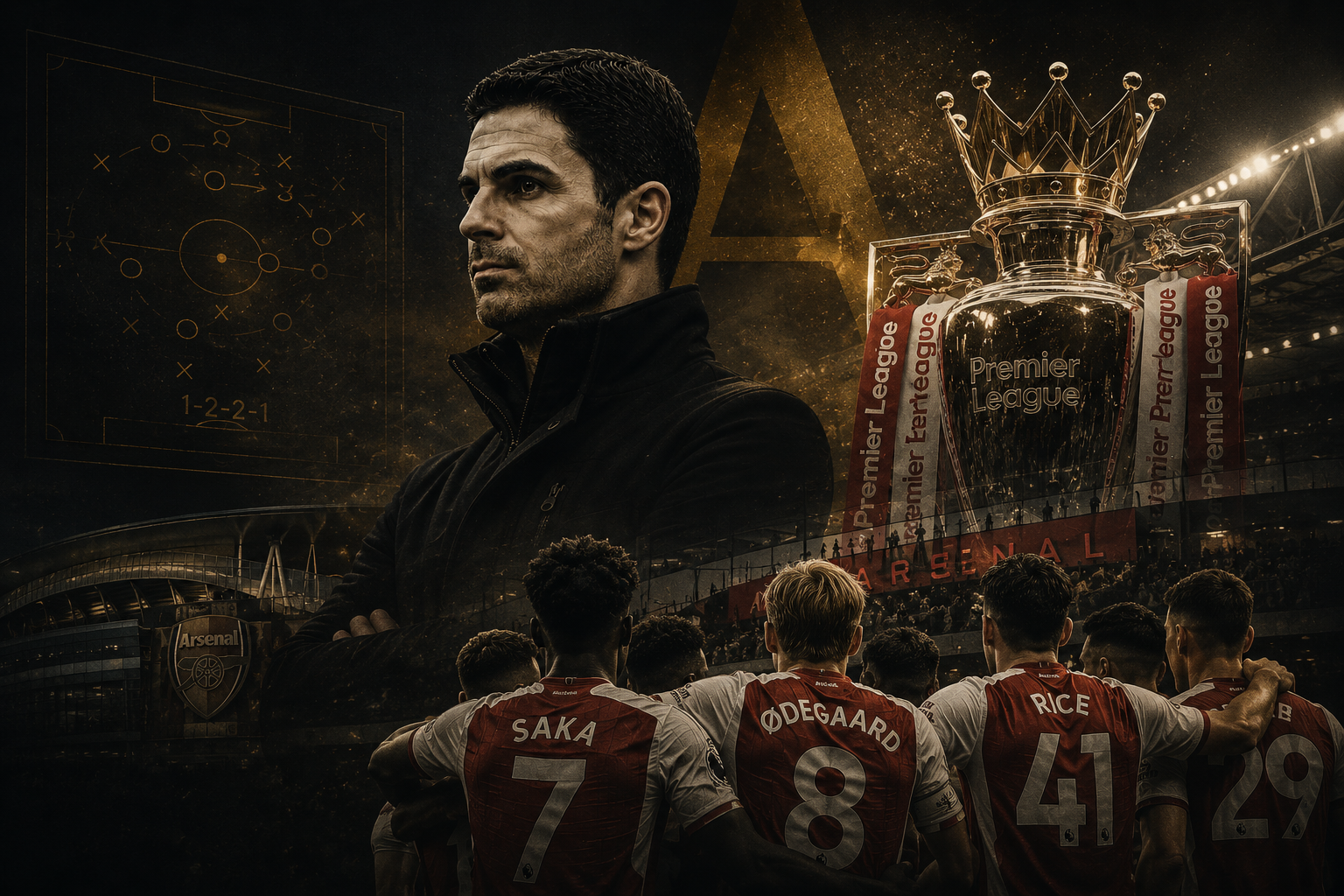
The last time Arsenal were champions of England, Mikel Arteta was 21 years old, playing for Rangers, and the Premier League trophy had not yet developed the engraved tradition that lists every champion of the modern era. The 2003-04 Arsenal side that finished the season undefeated was a closed chapter the day Patrick Vieira left, and the twenty-two years that followed were the longest sustained absence from the summit any version of the club had ever known. Four managers. A stadium move. Five FA Cups. A Champions League final exit. Three second-place finishes in four seasons. One eighth-place season under the man who would, against all sensible odds, eventually fix it.
Arsenal’s twenty-two years contained six distinct rebuilds, each chasing a different version of the same answer. The post-Invincibles transition of 2004 to 2008 was the first — Vieira to Juventus in the summer of 2005, Pirès to Villarreal in 2006, Henry to Barcelona in 2007, the spine of the unbeaten side sold off one by one as the cost of the new stadium began to bite. Project Youth, the 2008-to-2013 era under Wenger in which Adebayor, Touré, Nasri, Fabregas and finally Van Persie all left for clubs that could pay them more, was the second. The Özil-and-Sánchez investment phase of 2013 to 2018, in which the club returned to the high end of the transfer market and won three FA Cups but finished outside the top four for the first time in twenty years, was the third. The Unai Emery interregnum of 2018 to 2019, the post-Wenger reset that lasted eighteen months and produced one Europa League final and a fifth-place finish, was the fourth. The Arteta clear-out of 2020 to 2021 — Özil, Sokratis, Mustafi, Aubameyang’s captaincy and contract, the eighth-place season — was the fifth. And the Edu-and-Berta youth pivot that ran from the summer of 2021 through to the 2025-26 title was the sixth. The first five all ended without a championship. The sixth is the one Arteta finished.
On the evening of May 19, 2026, when Erling Haaland’s deep-injury-time equaliser at the Vitality Stadium failed to take three points from Bournemouth, the arithmetic that had been creeping toward inevitability since February resolved into certainty. Arsenal, on 82 points with one game still to play, could no longer be caught. The title was theirs. The drought was over. And the six-and-a-half-year project that began with a 1-2-2 inheritance and an eighth-place season had, finally, produced the only outcome that ever counts.
The inheritance, December 2019
It is worth remembering, because the recency of Arsenal’s success makes it easy to forget, exactly what Arteta walked into. The club was outside the European places under Freddie Ljungberg’s interim spell, the senior dressing room was split between two competing factions, the recruitment department was in the middle of a public re-organisation under Raul Sanllehi, and the marquee signing of the previous summer, Nicolas Pepe, was already being discussed as a write-off. The squad had a 32-year-old centre-back partnership, no functional pressing structure, and a striker — Pierre-Emerick Aubameyang — whose contract negotiations would dominate the next eighteen months of internal politics.
The thing Arteta inherited that mattered most, in retrospect, was a co-owner in Josh Kroenke and a managing director in Vinai Venkatesham who were prepared to take an extraordinary view of time. The standard tenure in elite football is two and a half years. Arteta was given six. That decision, more than any tactical instruction or transfer, is the single corporate choice without which none of the rest of this story exists.
The clear-out, 2020-2021
The early Arteta was a Guardiola understudy in the most obvious sense. The 2019-20 Arsenal that won the FA Cup in August 2020 — the COVID-empty Wembley final against Chelsea, Aubameyang’s two goals, the David Luiz and Pablo Marí centre-back partnership — was a faithful positional-play imitation in a team that did not have the personnel to execute it cleanly. The 2020-21 season was, in turn, the worst of his managerial career and the period during which he made the decisions that would define everything that came afterwards.
The Mesut Ozil exclusion in October 2020 was the first signal. The Sokratis exclusion came in the same window. The Aubameyang captaincy was stripped fourteen months later, in December 2021, and the player’s contract was mutually terminated two months after that. Each of these moves was, in isolation, a cultural risk. Taken together, they were the most decisive removal of a dressing-room status quo any new manager in the club’s modern history had ever attempted. Eighth place, no European football for the first time in twenty-five years, and a public confidence vote from the board that the project would continue regardless. That confidence vote — given, crucially, before the rebuild was producing results — is the corporate decision that the wider football industry has consistently underrated in any account of how Arsenal got here.
The pivot to youth, 2021-2023
The pivot was complete in the summer of 2021. Ben White, Aaron Ramsdale, Martin Ødegaard on a permanent, Takehiro Tomiyasu, Sambi Lokonga — five signings, average age twenty-two, all of them starters within a fortnight of arrival. Behind them, the academy graduates Arteta had inherited but not yet trusted began to play full seasons: Bukayo Saka in a permanent right-wing slot, Emile Smith Rowe in the No.10, Gabriel Martinelli rotating into the front three, Folarin Balogun developing toward a loan that would briefly threaten to become a permanent move. The William Saliba situation — three years of loan football in France before his Arsenal debut in August 2022 — was the longest-running and most divisive of the youth-pivot stories, and ultimately the most consequential. By the time he was reintegrated, Saliba was not a 21-year-old finding his feet. He was a fully formed elite centre-back who walked into a settled defensive structure and immediately made it one of the best in Europe.
The 2022-23 season was the first season in which the rebuild produced a serious title challenge. Arsenal led the Premier League for 248 days, dropped points at Anfield in April after leading 2-0, lost the Etihad fixture in the same window, and conceded the title to Manchester City over a five-week run. Five points behind, second place, eighty-four points — the highest non-title finish in the club’s history. It was, with the benefit of distance, the necessary calibration year. The squad had been overestimated, and the recovery from the City run was a question of structure rather than personnel.
The Rice signing and the second near-miss, 2023-24
The Declan Rice signing in July 2023 was the single largest transfer in the club’s history and the single most important. It addressed the only positional gap the 2022-23 team had not been able to mask: a midfield two of Granit Xhaka and Thomas Partey, in which Xhaka’s transition from a defensive eight to a left-sided creator had been remarkable but had also left the team perennially short of a controller. Rice was that controller, and his arrival reorganised the entire midfield. Ødegaard remained the right eight. Kai Havertz, signed in the same window for £65m and initially derided, was redeployed first as a false nine and then as a left eight in the second half of the season — the position from which he would emerge, in 2024-25 and 2025-26, as the most productive secondary scorer the team had.
The 2023-24 season produced 89 points and another second place, two points behind City. The decisive stretch was the four days in mid-April when the season turned: the 0-2 home defeat to Aston Villa on the Sunday that effectively ended the title race, and the Champions League quarter-final elimination at the hands of Bayern Munich at the Emirates the following Wednesday. Back-to-back home losses, four days apart, both of them in front of the home crowd — it was the closest the project had come to the kind of late-season collapse that ends managerial cycles. The board, again, held. The recruitment continued. The rebuild added David Raya as Ramsdale’s permanent replacement, Riccardo Calafiori as the long-term left-sided centre-back option, and Mikel Merino as a midfield rotation piece.
The third near-miss and the structural decisions, 2024-25
The 2024-25 season is the one that has been the hardest to write about in the immediate aftermath of Arsenal’s title win, because it is the season in which the gap between the visible football and the underlying foundations was at its widest. Arsenal finished second again. Liverpool, under Arne Slot, won the title at a canter. The Champions League run to the semi-final — the Real Madrid quarter-final, the eventual exit to Paris Saint-Germain — was the deepest the club had been in Europe in two decades. And the league campaign, while statistically excellent, was punctuated by an injury crisis that lost Saliba, Calafiori, Saka, Merino, Havertz and Gabriel Jesus across overlapping windows.
The internal story of that year was the appointment of Andrea Berta as sporting director in March 2025, the departure of Edu Gaspar for a multi-club football ownership role two months earlier, and the recalibration of the recruitment pipeline that those two moves jointly produced. Berta’s first summer window — Eberechi Eze from Crystal Palace, Cristhian Mosquera from Valencia, Christian Norgaard from Brentford, Martin Zubimendi from Real Sociedad — added the depth and the physical profile the previous summer had been criticised for missing. Each signing was, in its own way, a response to a specific structural weakness the 2024-25 season had exposed.
The other structural decision, less visible but more important, was the deepening of the set-piece programme. Nicolas Jover had been on the staff since 2021. By 2025-26 the corner and free-kick department had been expanded, the dedicated video analyst pipeline had been formalised, and Arsenal’s set-piece xG conversion was the highest in Europe by a margin that bordered on absurd. Twenty-three Premier League goals from dead-ball situations across the title-winning season. Six match-deciding goals in single-goal wins. The set-piece programme was the most cost-efficient marginal-gain operation in the modern game, and it was the single tactical area in which Arteta’s Arsenal had decisively and permanently overtaken the Guardiola template they had originally been built against.
The 2025-26 title, and what it actually proves
The team that finished the job did not look like the team that started the journey. It did not look like Guardiola’s City. It did not, even at its most fluid, look like the Klopp Liverpool that had set the previous benchmark for Premier League dominance. What it looked like was a hybrid: positional in the buildup, gegenpressing in the rest-defence, physically dominant in transition, ruthless on the set piece, and goalkeeper-led in the recovery phase. Three central spines — Raya, the Saliba-Gabriel partnership, Rice-Zubimendi or Rice-Merino, Ødegaard-Havertz — that played seventy per cent of the available minutes between them. A squad in which the leading scorer (Saka, sixteen goals) was the most prolific contributor but not a dominant one, because the goals had been deliberately distributed across the eleven.
The most quietly impressive number from the title-winning season was, by some distance, the goals-against column. Thirty-one goals conceded in thirty-seven games — the best defensive record in the league by a comfortable margin and the lowest a champion side had managed in the modern Premier League era outside of the Mourinho Chelsea seasons. The combination of Saliba’s recovery pace, Gabriel’s aerial command, Calafiori’s left-sided ball progression, and Mosquera’s depth contribution was a quartet of centre-backs that almost no other side in Europe could match in their first-choice grouping, let alone in their depth.
What the twenty-two years actually mean
The temptation, with this much history compressed into a single result, is to make the title win larger than it is. The reality is more modest and more impressive. Arteta did not invent a new way of playing football. He did not, in the Pep sense, redefine an era. What he did was take the slowest, most patient, and most expensive path back to the top of a competition that had, for two decades, treated Arsenal as a club that lived adjacent to greatness without being able to enter the room. Six years. Three second-place finishes. One Carabao Cup, won as a calibration trophy in February. One Premier League title, won with a game to spare.
Twenty-two years is also a number that matters because of who it includes. Arsene Wenger’s last title was 2003-04. The two decades between then and now contained the era of City’s hegemony, the era of Mourinho’s three Chelseas, the Klopp Liverpool, and the brief Leicester aberration. To win in 2025-26, on the back of a project that survived an eighth-place season and three second-place hangovers, is to have done the version of this rebuild that nobody in modern English football has previously completed at this scale.
The Champions League is still missing. The Bayern semi-final defeat in April 2026 — a 2-2 first leg at the Emirates, a 1-0 reverse at the Allianz, the away-goals rule no longer applicable but the underlying performance margins still the same — remains the largest unticked box. The 2026-27 squad will be assembled to address that, and the recruitment summer that is about to begin will be the most ambitious of the Berta era. Arteta will have his settled spine, his deepened squad, the additional confidence of a champion’s medal in the dressing room, and the institutional patience of a club that has just been rewarded for having held it longer than any other in this league.
For tonight, though, the only number that matters is the one that read 82-78 on the table at the moment Haaland’s equaliser failed to keep City alive. Champions for the first time in twenty-two years. The drought is over. The next chapter starts in August.