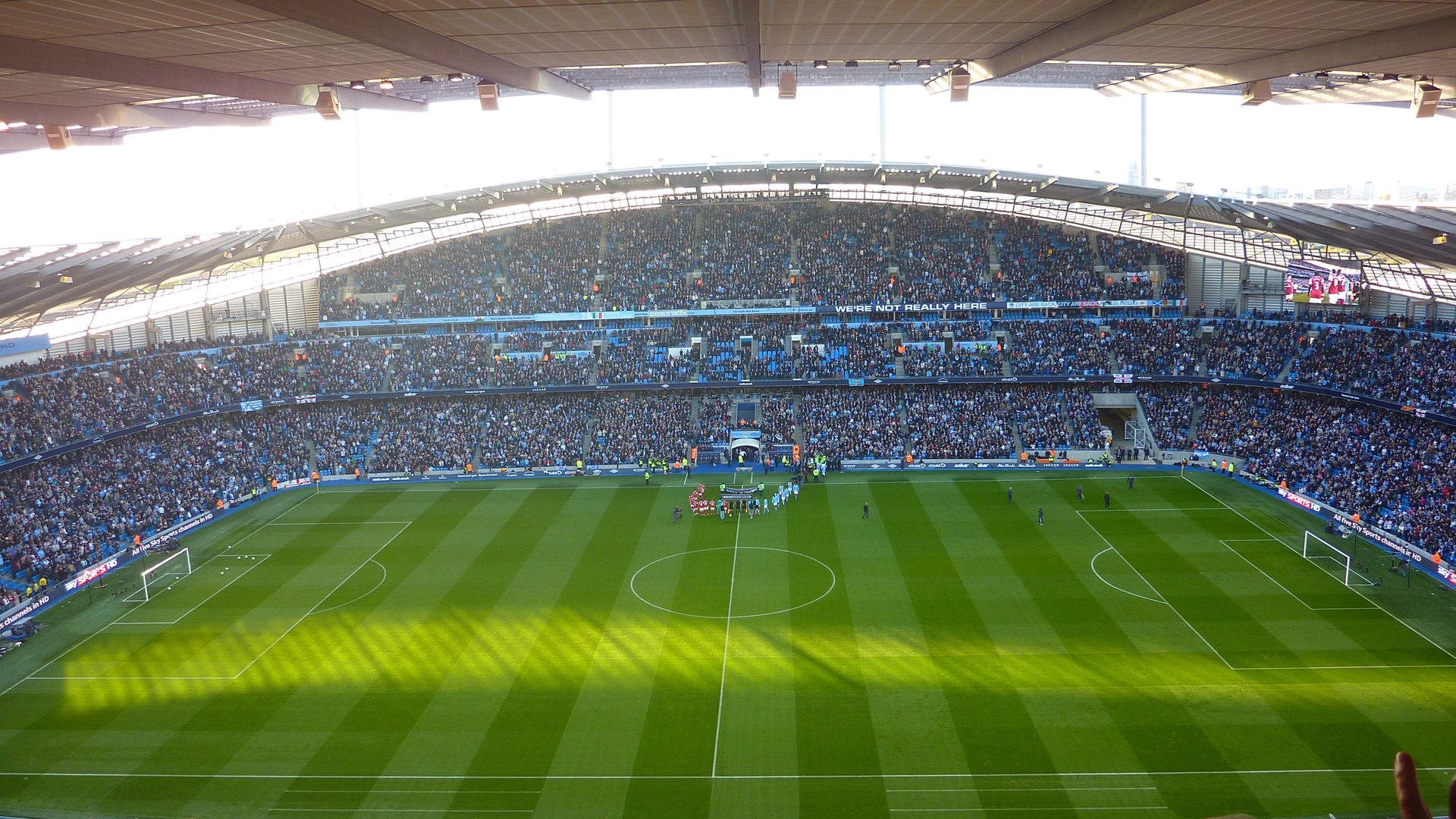
There were ninety minutes at the Etihad on Sunday, April 19, that may end up reshaping the Premier League title race. Manchester City beat Arsenal 2-1 in the kind of compressed, high-stakes fixture the season’s table positions had been quietly setting up since the autumn. Arsenal had led the table for most of the campaign. City had been within striking distance for weeks. The match closed the gap to three points (with City holding a game in hand), and reframed a title race that — on the strength of Arsenal’s earlier consistency — most observers had begun to treat as decided.
It was not decided. It is, on the evidence of this match, more open than it has been at any point since November.
This is the tactical breakdown of how the result happened, what it tells us about both teams’ April form, and what it implies for the run-in.
The Lineups
Pep’s City started in their 4-2-3-1: Donnarumma in goal; Nico O’Reilly at left-back, Marc Guéhi alongside Abdukodir Khusanov in the centre, Matheus Nunes at right-back; Rodri and Bernardo Silva as the double pivot; Jérémy Doku on the left of the attacking three, Rayan Cherki centrally as the false-ten and Antoine Semenyo on the right; Erling Haaland alone up top.
The team-sheet was distinctive in two respects. First, Cherki was again preferred over Phil Foden as the central creative pivot. Foden picked up an ankle injury on England duty against Uruguay earlier in the month — a Ronald Araújo tackle that has limited his minutes since — and Cherki has been the principal beneficiary of the absence. Second, Marc Guéhi’s partnership with Khusanov has, in a relatively short integration window, become the most stable defensive partnership City have run all season. Khusanov arrived from Lens in January 2025 and has had eighteen months to embed; Guéhi was the £20m January 2026 deadline-day arrival from Crystal Palace. The pairing is two windows old. The fluency is older than that.
Arsenal lined up in their 4-3-3 — Raya in goal; Mosquera, Saliba, Gabriel and Hincapié across the back; Rice, Zubimendi and Ødegaard in midfield; Madueke, Havertz and Eze as the front three. The teamsheet reflected an Arsenal still managing significant absences. Bukayo Saka has been out with an Achilles problem since the Carabao Cup final. Mikel Merino has been sidelined since February with a broken foot. Riccardo Calafiori was again unavailable, with the converted-centre-back Piero Hincapié continuing at left-back. Gabriel Martinelli’s persistent fitness concerns kept him out of the starting eleven. Eberechi Eze, signed from Crystal Palace last summer to provide exactly the kind of central-creative cover Arsenal would need without their injured headline names, started in the 10/wide-attacker role.
The personnel choices were forced. The tactical intent was the question.
The First Half — Cherki’s Goal and Donnarumma’s Mistake
The opening sixteen minutes were an early demonstration of what Pep had drawn up. City’s build-up shape — the inverted-fullback structure with Nunes stepping into midfield from the right and Khusanov-Guéhi splitting wider in possession — produced two early progressive sequences that Arsenal’s mid-block did not fully cover.
Cherki’s opener arrived from the second of these. The Frenchman received the ball thirty yards from goal, glided past Gabriel as if the centre-back were not there, beat one further defender in the box and finished low into the bottom-left corner past Raya. The goal was the kind of pre-rehearsed combination that Pep’s City have run dozens of times this season — the fluid rotation between an inverted fullback, a roaming 8 and a false-9-style centre forward, with Cherki the chief beneficiary of the geometry. Cherki has been Pep’s most successful summer-2025 signing, and the goal was the case-in-point for why.
The reply was unexpected. Two minutes after the City goal, Donnarumma made the kind of in-possession mistake elite goalkeepers occasionally produce on the days they are pressed unusually high — a slack distribution off a clearance that put the ball at Havertz’s feet twelve yards out. The German finished with the kind of composure the situation demanded. The goal was the most uncharacteristic moment of Donnarumma’s City season and, in title-race terms, the kind of moment that magnifies into a season-defining error if City do not respond.
The forty minutes between Havertz’s equaliser and half-time were the most evenly contested phase of the match. Arsenal’s depleted attacking three pressed City’s build-up more aggressively after the goal — Madueke and Eze stepping up onto Khusanov and Guéhi when the ball reached them, with Rice jumping into Rodri’s space. The press fired correctly on roughly a third of City’s build-up sequences in that twenty-minute window, and produced two clean turnovers that did not, by the narrowest margins, become Arsenal goals.
The half ended 1-1. The underlying numbers — possession at 58.6% to City, shots-on-target 5-3 in their favour, and a slight territorial dominance — undersold how fine the contest had been. Arsenal, despite their depleted personnel, had looked for a stretch like the more likely scorer of the next goal.
The Tactical Adjustment at Half-Time
Pep’s half-time response was the kind of small structural change that has, over the past five years, separated his City from the elite teams that try to play the same way. The adjustment was on Bernardo Silva.
In the first half, Bernardo had been the shuttler — sometimes drifting wide right when Doku came inside, sometimes operating as a third midfielder when City’s pivot needed reinforcement. After the break, Pep restricted his role to the right halfspace, with explicit instructions to occupy the seam between Hincapié and the Arsenal left-side attacker. Hincapié, natively a centre-back, was already playing out of position; Bernardo’s repositioning compounded the problem by forcing the Ecuadorian into the kind of decision-making — follow the inside drift or hold the line for the touchline run — that an emergency left-back is least equipped to make against elite opponents.
The change shifted the territorial balance. From the 50th minute onwards, City’s right-side attacks accounted for roughly two-thirds of their possession in the final third. Arsenal’s response — sliding the back four right and asking Zubimendi to drop deeper — created the kind of central-zone vulnerabilities that, on the 65th minute, produced the goal that decided the match.
The Goal that Decided It
Haaland’s winner was the simplest of the three goals on the day. A driving run from Nico O’Reilly down the left ended in a cross that Rodri helped on with a deft flick into the path of Haaland, who swivelled inside the area and finished beyond Raya into the bottom-right corner. The goal was the consequence of the half-time adjustment as much as the individual quality of the finishers — by forcing Arsenal to defend the right side more aggressively, Pep had created the central-zone gap that O’Reilly’s overlap on the opposite flank exploited.
Arsenal’s response in the final twenty-five minutes was honourable. Arteta turned to his bench, with Trossard and Ben White among the introductions, looking for a different kind of central-creative threat. Madueke produced two near-misses that, on a different day, would have been the goals that took the match into stoppage-time chaos. The clear chances Arsenal needed did not arrive. The shape of the match, after Haaland’s goal, was the shape Pep wanted: City compressing the play, asking Arsenal to take risks they had not been asked to take all season, and absorbing the resulting pressure with the kind of structural composure his teams have been refining for a decade.
What This Means for Arteta
The post-match reaction from Mikel Arteta, in his measured way, was the verdict of a manager who had watched a specific tactical adjustment, made by an opposite number with twice his managerial experience, decide a match he had brought a depleted squad into. The deeper concern is the recurring pattern. Arsenal have, in 2025-26, dropped points in most of the marquee fixtures — the goalless draw with Liverpool in January, this defeat at the Etihad — and the in-match tactical response to elite opponents who change shape mid-game is, on the evidence, the structural weakness Arteta’s coaching staff has not yet fully resolved.
The squad’s quality is not the issue. The squad’s depth was visibly the issue on Sunday — playing without Saka, Merino, Calafiori and a fully-fit Martinelli is the kind of attritional load Arsenal’s first-XI has not previously been asked to carry against an elite opponent. The points total, after this defeat, is still the best Arsenal first-XI accumulation in modern history at this stage of a season. The title race, however, is no longer in their hands.
What This Means for City
For Pep, the win was, in some sense, the validation he had not been granted by the Champions League exit to Real Madrid in March. The same City team that had been beaten 5-1 on aggregate over two legs in the Round of 16 — outplayed comprehensively in the Bernabéu first leg, then losing 2-1 at home with ten men — looked, in this match, structurally restored. The Cherki-Bernardo-Doku triangle in the final third produced four high-quality chances. Rodri, who had been below his peak level in March, looked closer to the player whose 2024 Ballon d’Or had not been an upset.
The deeper point about City’s performance is that the squad construction, three transfer windows in, finally looks complete. Cherki has been the catalyst the central creative position needed. Khusanov has provided the defensive partner Rúben Dias’s persistent injury issues required, and Guéhi’s January arrival has settled the back-four rotation. O’Reilly’s emergence as the left-back option has eased the structural tension between Pep’s preference for inverted full-backs and the squad’s actual personnel availability. The team that has won six Premier League titles in eight years is, on this evidence, ready to win a seventh.
The Run-In
City’s remaining Premier League fixtures: Brentford (home), Everton, a game-in-hand against Crystal Palace, Bournemouth (away, 17 May), Aston Villa (home, 24 May). Plus an FA Cup final against Chelsea at Wembley on 16 May.
Arsenal’s remaining Premier League fixtures: Newcastle (home, 25 April), Fulham (home), Burnley (home), West Ham (away), Crystal Palace (away). Five matches, all in London, no fixture against another top-six side remaining.
The mathematics, after Sunday: City need four wins from five league matches to claim the title outright (assuming Arsenal don’t drop further points). Arsenal need to win their remaining matches and hope City stumble. The Newcastle visit on April 25 is the immediate test of how the squad’s depleted spine recovers from this result.
I have been writing about Premier League title races for two decades. The 2025-26 race, after this Etihad result, has the texture of the great closing-weekend dramas the Premier League has produced over the years. The 2012 Aguero moment. The 2014 Liverpool collapse. The 2019 City-Liverpool 98-point shootout. The current race may, on the form of both clubs and the depleted state of Arsenal’s attacking third, end with a similar narrative — though the closing-weekend drama, on the run-in fixture map, may now be more about whether Arsenal can hold their nerve than whether City can catch them.
I will be watching the next five weekends with the kind of attention that, in any other April, the question would not have justified. Sunday at the Etihad changed the shape of the answer. The answer itself is, on the underlying numbers, going to arrive in the final ninety minutes of the Premier League season.